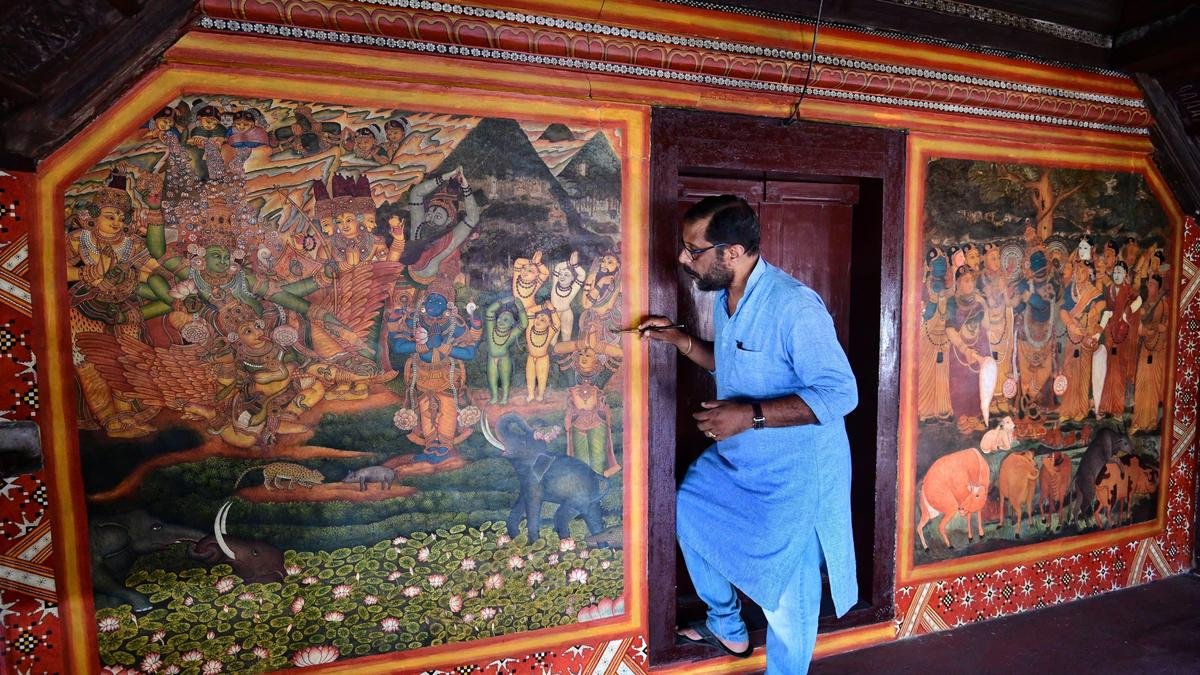

Not many know that the Fort Palace complex or Karuvelipura Malika, which extends up to the eastern entrance of the Sri Padmanabhaswamy Temple in Thiruvananthapuram, has been home to centuries-old artistic treasures. And that a historic activity has been going on inside this historic structure for the last five months. The three murals, believed to be painted during the reign of Marthanda Varma, the visionary ruler of erstwhile Travancore (1729-1758), were being restored by mural artist and art researcher Saju Thuruthil.
(From left) Sriram Pattabhishekam before and after renovation. Photo Credit: Special Arrangement
The three frescoes are Sriram Pattabhishekam, Venugopalam and Gajendramoksham. The grand palace complex, also called Rod Malika, with traditional architecture dating back over three centuries is topped by the famous clock tower or Methan Mani and currently houses the administrative office of the temple trust.
“These works are unique in the sense that they are the only works in the Fort Palace style or Karuvelipura style that have survived,” says Saju, director of the Center for Mural Heritage Conservation Studies at Sri Shankaracharya Sanskrit University, Kalady, who also runs a residential art gallery, Art and Mind, in North Paravur, near Kochi.
There are different styles of mural painting, says Saju, who has over three decades of experience in the field, such as Mattancherry, Pundarikapuram, Panayannarakvu, Padmanabhapuram Palace, Guruvayoor etc. “The Fort Palace style is much less famous. But it is rich in terms of appeal. The jewellery, costumes, body type etc. make it different from other styles.”
There is a huge Tamil influence here, says Saju, especially with regard to jewellery, be it neck jewellery, bangles, hair accessories or nose pins. “Women are seen wearing pichipoo (A type of jasmine) also. The color combination is also unique.”
The restoration work was initiated under the direction of members of the erstwhile Travancore royal family, Pooyam Thirunal Gowri Parvathi Bai and Ashwathi Thirunal Gowri Lakshmi Bai.
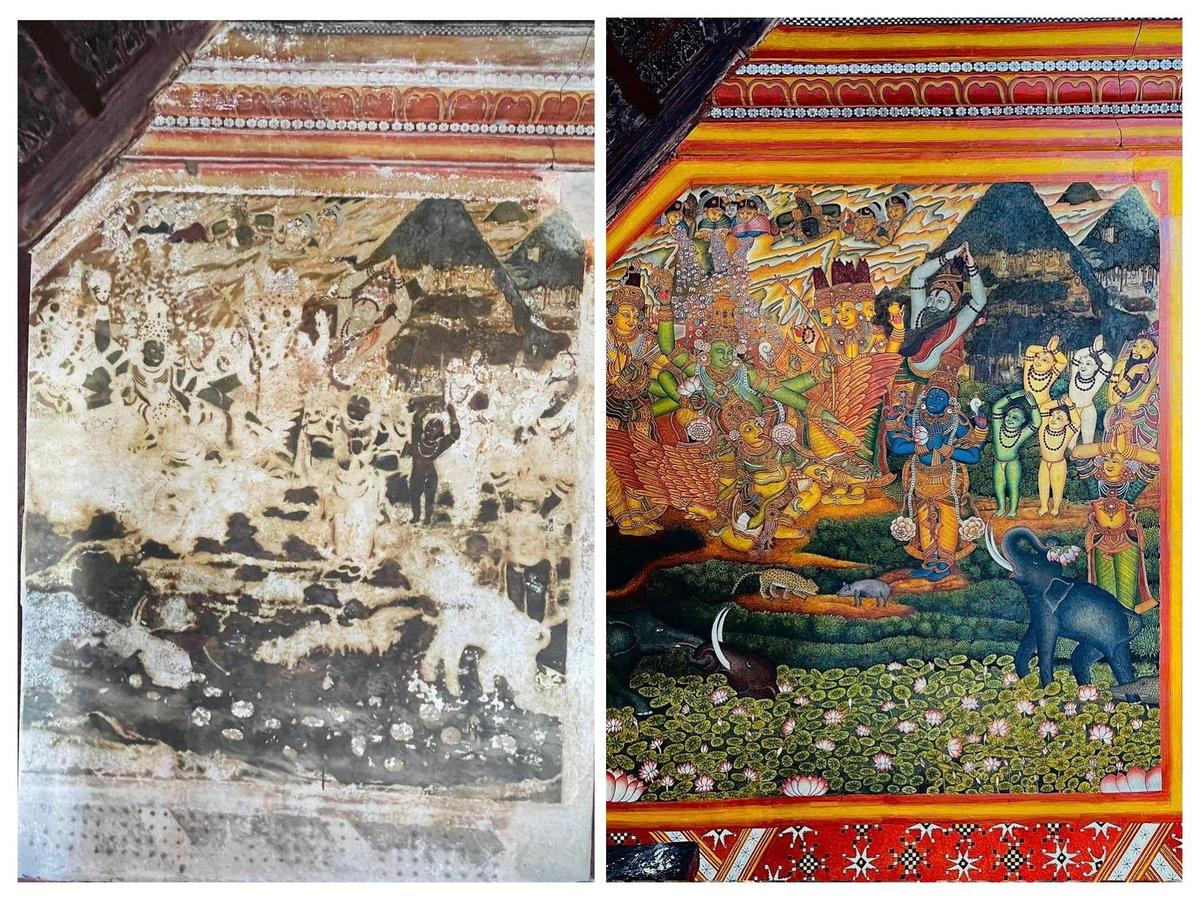
(From left) Gajendramoksham before and after restoration. Photo Credit: Special Arrangement
This process was far from easy. He says, “Not many of the original paintings were left when I started this project. They were not only faded, but also had scratches, stains and were in a dilapidated condition due to years of neglect. The Gajendramoksham was in the worst condition, while the Venugopalam had only one figure visible.”
Once the dirt and grime were removed using isopropyl alcohol, acetone and other materials, the walls were strengthened, cracks filled and scientific restoration was carried out.
Saju says that although the renovation was done several decades ago, it was not done properly. “Since varnish was not available at that time, I think he used French polish. This blackened the paintings. We had to clean it using acetone before applying the color. If he had not done this we could have done a better restoration.”
According to him the main attraction of the paintings is that they are a blend of traditional Kerala mural tradition and miniature Rajasthani painting techniques. “Which means there must have been an artist from that part of the country in the court of Marthanda Varma. Using a hairy brush, the artist has done so much detailing! But for some cleaning and application of colours, I have not done much to the miniature landscape in all three paintings.”
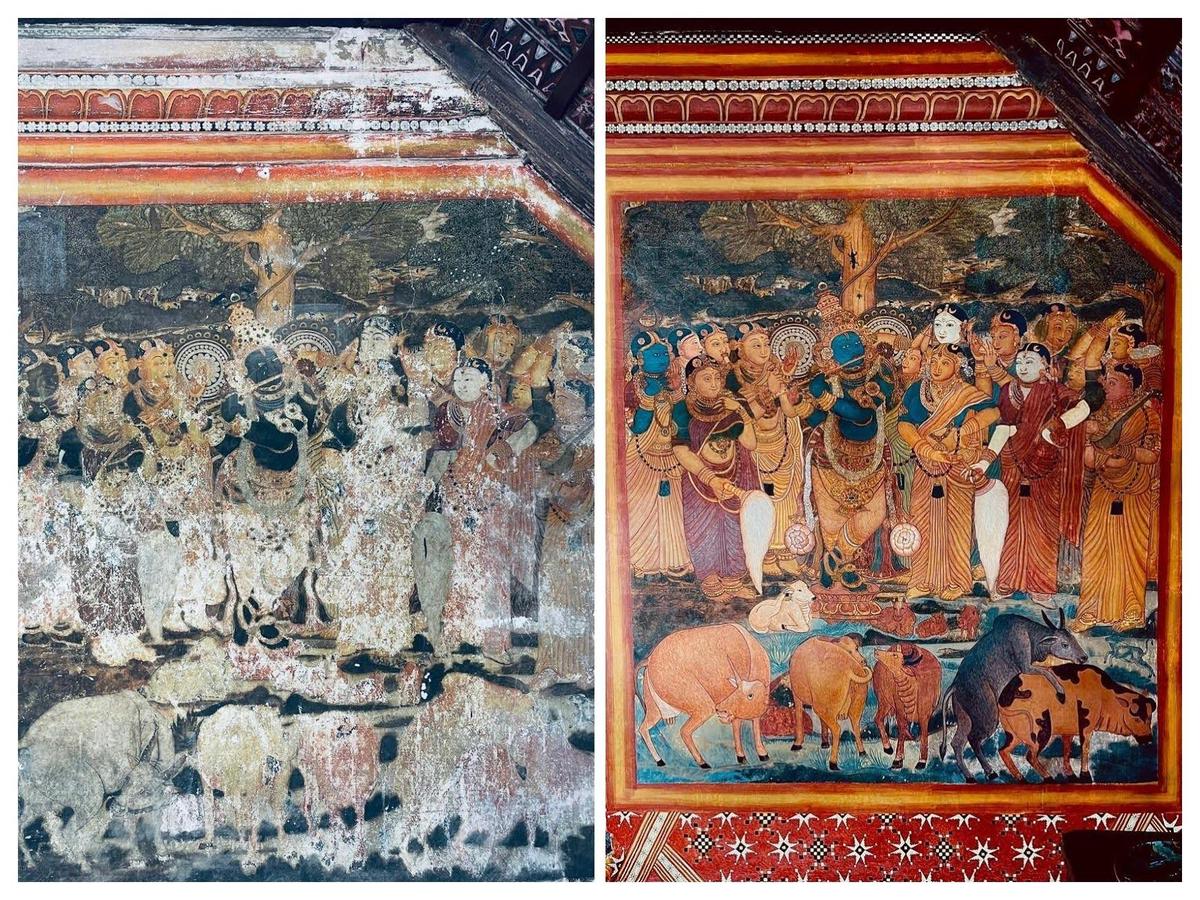
Venugopalam before and after restoration. Photo Credit: Special Arrangement
He also points out that scenes of Marthanda Varma and his prime minister, Ramayana Dalava, who contributed extensively to the running of affairs in Travancore, are included in Sriram Pattabhishekam. “This is surprising. This may have been an attempt by the artist to please his king. Interestingly, the portrait of Marthanda Varma as we see it today is inspired or copied from the face shown in this fresco.”
Venugopalam sees the scene of Vrindavan on a full moon night, when Krishna plays the flute with the entire universe – humans, birds, animals, celestial figures… attracted towards him. “This Venugopalam is different from those I have seen at other places because usually artists depict Krishna and Gopikas playing the flute. But in this particular work the imagination has gone wild with the inclusion of so many elements in nature. The miniature components speak volumes about the skill of the artist.”
He further said that it seems that there was another mural inside the complex, possibly Shakti Panchakshari, which displays Lord Shiva and Parvati. It may have been removed inadvertently while cleaning the walls.
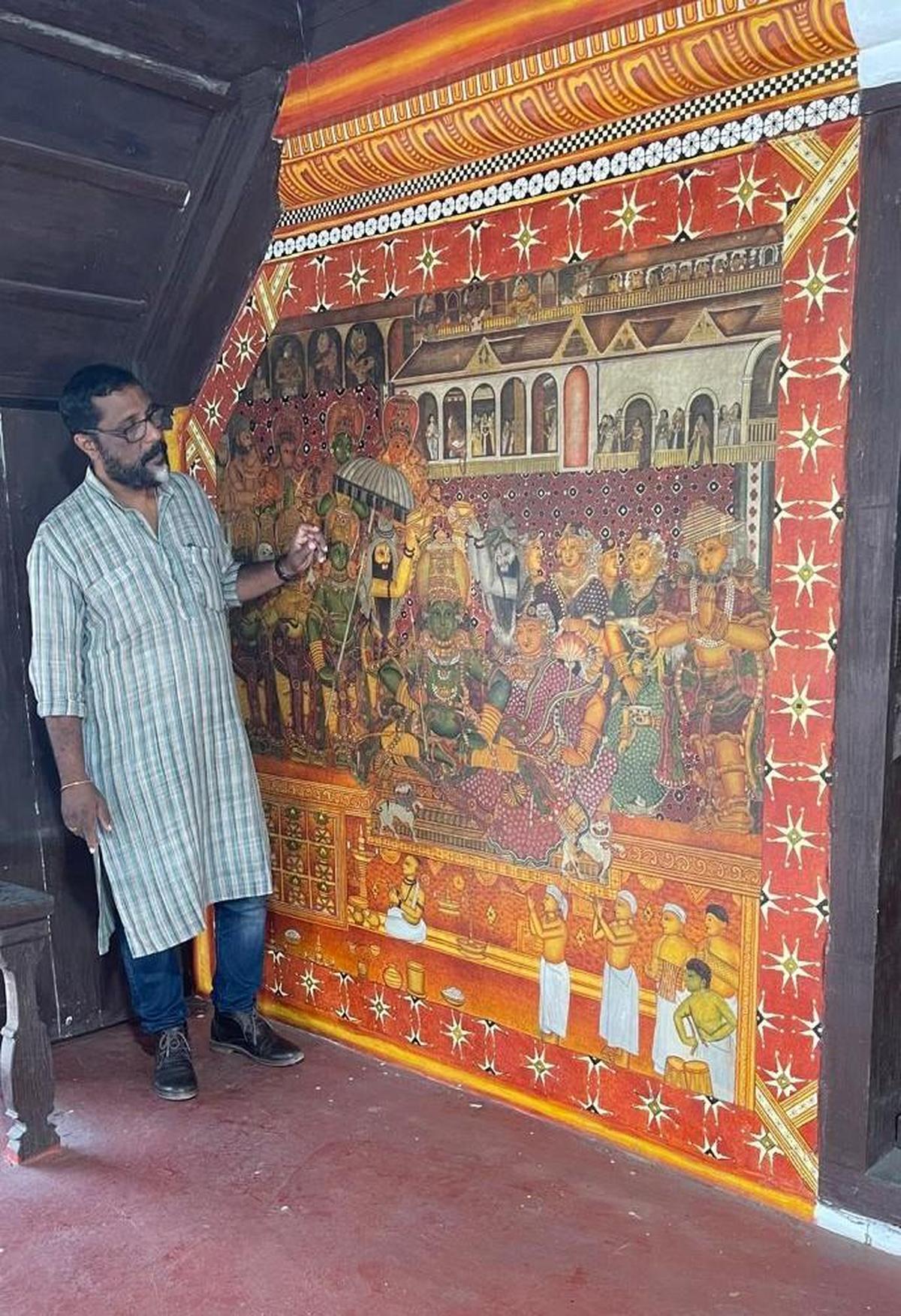
Saju Thuruthil renovated them with Sriram Pattabhishekam murals. Photo Credit: Special Arrangement
According to Pooyam Thirunal Gowri Parvathi Bai, the family wanted to preserve the works as they are unique. “We knew it would be a painstaking job. So we wanted someone who had the time and expertise to do it. That’s how we identified Saju and he was excited to do it. We are extremely happy with the way he has restored them. The way he has brought them back to life, it looks like he enjoyed it.” She adds, “We want artists and art students to see these murals and understand their importance. Since we cannot allow large crowds for various reasons, the plan is to bring people who understand this art, but in small numbers.”
Meanwhile Saju is working on a book dedicated to the entire restoration process.
published – January 14, 2026 03:34 PM IST