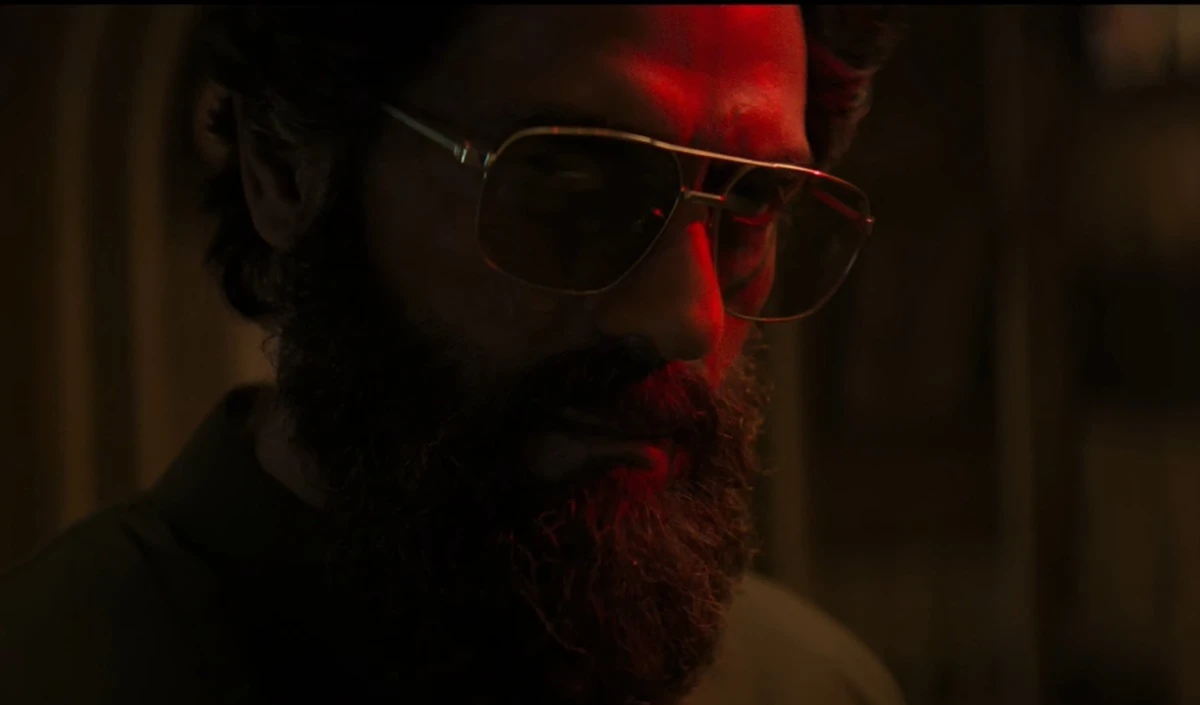

In Hindi cinema, villains are often either roaring or ruthless without reason. But Major Iqbal (Arjun Rampal) in the film ‘Dhurandhar’ had a different beginning. He is a man who calmly explains his ideology while making precise cuts on one’s skin. That dialogue in the first part of the film – “Bharat ka ahaz zakhum ke khoon vahaya karo” – was enough to make the audience laugh. But could this character sustain that fear till the end?
The beginning of an ideological villain
Major Iqbal is not the only angry opponent. He is an ISI agent who links Karachi’s criminal gangs with state terrorism. The most terrifying aspect of his brutality comes out during 26/11, where he is connected to a satellite phone not only to give instructions but also to ‘hear’ the screams of innocent people.
This is not a strategy, but a deep ideology. He is carrying the psychological wounds of 1971 and feels that what he is doing is a ‘sacred mission’. Arjun Rampal plays the character like a man of faith, whose twinkle in his eyes and firm jaw show that there is no room for doubt in his faith.
The first part of the film (Part 1) pretty much completes this introduction. Although he is not shown as the main villain of the story, Major Iqbal acts with complete authority and authority. When the second part of the film (Part 2) arrives, the audience’s expectations are clear: this is the man Hamza is finally moving towards; It is a power that has to be destroyed at all costs. And if we see it on paper, this character fully proves this expectation of the audience.
You can take this as a break or a warning – you might want to go to the theaters first and watch Arjun Rampal do a great job as Major Iqbal. But if you want to read on (and you should), this is where the film reveals its true secret.
Also Read: Aryan Khan Drugs Case: Did Sameer Wankhede Demand Rs 25 Crore Bribe From Shah Rukh Khan? What is the truth before the Bombay High Court?
Major Iqbal is not a stereotypical or typical villain. He is an ISI agent who links the criminal gangs of Karachi’s Lyari area with government-funded terrorist networks. He was in constant touch with the terrorists on satellite phones during the 26/11 attacks, directing their every move on the ground. But what makes it even more disturbing is his own confession: he’s not on the phone just to give instructions to the terrorists, he’s just there to listen. Hearing Indians cry, scream and suffer – something he himself admits to in a later scene in Part 2 of the film. This small difference changes the course of the whole story.
Also Read: Dhurendra Is My Revenge…, Arjun Rampal recalls the horror of 26/11, says – ‘Whatever I saw that night, I got my revenge in the film’
It’s not just a strategy. It’s an ideology that he’s living right now, right now. He is deeply affected by the psychological and ideological fallout of the 1971 war; He undertakes missions with the aim of recovering what he sees as lost. This is not superficial writing. It is a depiction of ideological extremism with a familiar human face.
Arjun Rampal as the face of ideological extremism
Arjun Rampal understands this perfectly. This is perhaps one of the best performances of his career, where every scene has a purpose – the slight twinkle in the eye during the interrogation, the clenching of the jaw when he realizes he’s being outed, and the quiet weariness of a man whose belief system has become so rigid that there is no room for doubt.
He does not play Iqbal like a traditional villain. He plays him as a man of ‘faith’ – a man who is not pretending to be ruthless, but living within the framework of principles and ideologies in which he firmly believes. And thus terrorists are born – not in a moment, but carrying within themselves a carefully crafted story; Those stories are woven one by one, until no other truth exists for them than what they believe.
And as we begin to understand Iqbal beyond the ‘villain’ image that Bollywood has shown us, the mood of the film begins to change and the horror begins to subside. This is where ‘Dhurandhar: Da Badla’ reveals its most interesting layer and its biggest commercial layer: the father.
Entry of Suvinder Vicky’s character ‘Brigadier Jehangir’
Suvinder Vicky’s presence in those scenes changes the character radically. The moment he enters, the power dynamic collapses completely. Major Iqbal—the man who controls the network, manipulates the systems, and orders the violence—suddenly seems very small. There is a clamor for not being able to produce a son. A man being humiliated by a ‘patriarch’ in a wheelchair – a man who symbolizes everything that was broken by the 1971 war and which that war could never fix.
Taken in isolation, the writing is very strong. It humanizes the character, shows his inner brokenness, and prevents him from becoming a ‘one-note’ villain. But it also takes something too far. Because the more the film exposes this vulnerability, the less Iqbal feels like an ‘overwhelming force’. It is understood. And when it does, it seems less scary. And this is where the ‘structure’ of the film comes into play.
The different layers of Major Iqbal
In the first part (Part 1) Major Iqbal acts as the ‘Unseen Architect’. His presence carries a weight of its own, as the film is still building its world at that point. The interrogation, the logistics, his association with dacoit Rahman—all these prove him to be the real player behind the chess game. And most importantly, he goes with the power of Rahman, not under it. It is this balance that makes him so dangerous.
By the second part the structure of the story changes. It is no longer a confessional territory. It is the story of Hamza’s rise to power, his hold on power, the systematic dismantling of his network and his transformation into a powerful figure in Lyari. This structure fits perfectly with the film.
When everything changes
But in the process of elevating Hamza, Major Iqbal was sidelined. He stops driving the story, he starts reacting to it. He keeps track of the updates. He gets frustrated. He sees the system he built begin to crumble beyond his control. There is an aspect where this helplessness becomes tragic – a thinker defeated by the structure he has created – but the film does not fully embrace this idea.
Instead, this change has a different effect. The enmity between the two does not last forever. What starts as a chessboard turns into a ‘hit list’, and Iqbal himself becomes a target on that list. As the story reaches its final confrontation, the confession no longer seems to be the major obstacle that the first film quietly promised.
More spoilers
The climax in Muridake has everything that could have made it great — years of infiltration, psychological pressure, emotional manipulation — but it feels like an action scene when it should have felt like a moment of reckoning.
It needs memories, angst and a satisfying ending. Perhaps some glimpses of 26/11, echoes of that radio call, or the full circle of the story. One could argue that this is intentional—that Dhurandhar is not meant to glorify a traditional villain, but instead is deliberately subverting the idea of power; He is showing how even the most powerful people are actually based on weaknesses and illusions.
The incident involving the father also reinforces this interpretation and the weaknesses shown in Iqbal’s character also point in this direction. This approach is indeed insightful, but its implementation remains incomplete. Because the human aspect that gives depth to his character also diminishes his effectiveness as an antagonist. The father rips Iqbal off so badly that by the time the climax arrives, Iqbal doesn’t have enough room to re-establish himself as a threat in the story.
You’re watching a man who was cut short in the previous act, and who is now trying to regain control—but the film doesn’t give him the space or opportunity to do so. And that’s why the character of Major Iqbal doesn’t leave the impact it should, despite the brilliant writing and strong acting.
It is not because he is weak or in a different situation. Compared to a character like Rahman, Daku—whose story is deeply personal, dynamic, and emotionally charged—Iqbal maintains a distance; He is motivated by his ideology more than personal concerns. And in the world of cinema, personal feelings or relationships often win.