

When I visit textile artist Kalyani Pramod’s Chennai studio, she is sipping tea, surrounded by framed textile and paper works and photographs carefully arranged around the room. They are ready to be packed and sent to the Lalit Kala Akademi, the venue for his ongoing exhibition, Tribute to My Father, a personal tribute to his father, the late photojournalist TS Nagarajan.
“We were rich not in money but in experiences,” says Kalyani, reflecting on a childhood built on immersion in the arts. From the age of seven, she traveled across the country with her father, accompanying him to exhibitions and assignments, which established her in the world of photographers, dancers and artists. She says, “I think I became a designer because of him and his friends. We had different types of artists come to our house and it opened up a new world for me.”
For the exhibition, he has chosen some negative photographs of his father, which he has preserved and digitized over the years. Her textile and paper interpretations are displayed alongside each image – woven tapestries, miniature embroideries and delicate works on tea-stained paper that echo the original creations. In total, 82 pieces are on display, creating a visual dialogue between photograph, thread and memory.
Artifacts include tapestries woven from silk and wool, small black and white embroideries and images stitched onto used tea bags. The tea bags are opened and reused as canvas. “If you put your needle in a tea bag and you make a mistake, you can’t fix it. It just bursts,” she says, explaining the care demanded in the process.
Using tea bags as their canvas is also their way of reusing waste. An advocate of working with discarded materials, Kalyani often collects things that others throw away. Piles of textile scraps and salvaged remains are a familiar sight in her studio, waiting to be reimagined into art.
Notably, Kalyani has deliberately avoided photographing her father’s well-known personalities. Although Nagarajan has photographed political figures and public names, he has chosen to focus on images of their everyday lives, priests, vendors, women sitting along ghats, anonymous faces captured in mundane moments.
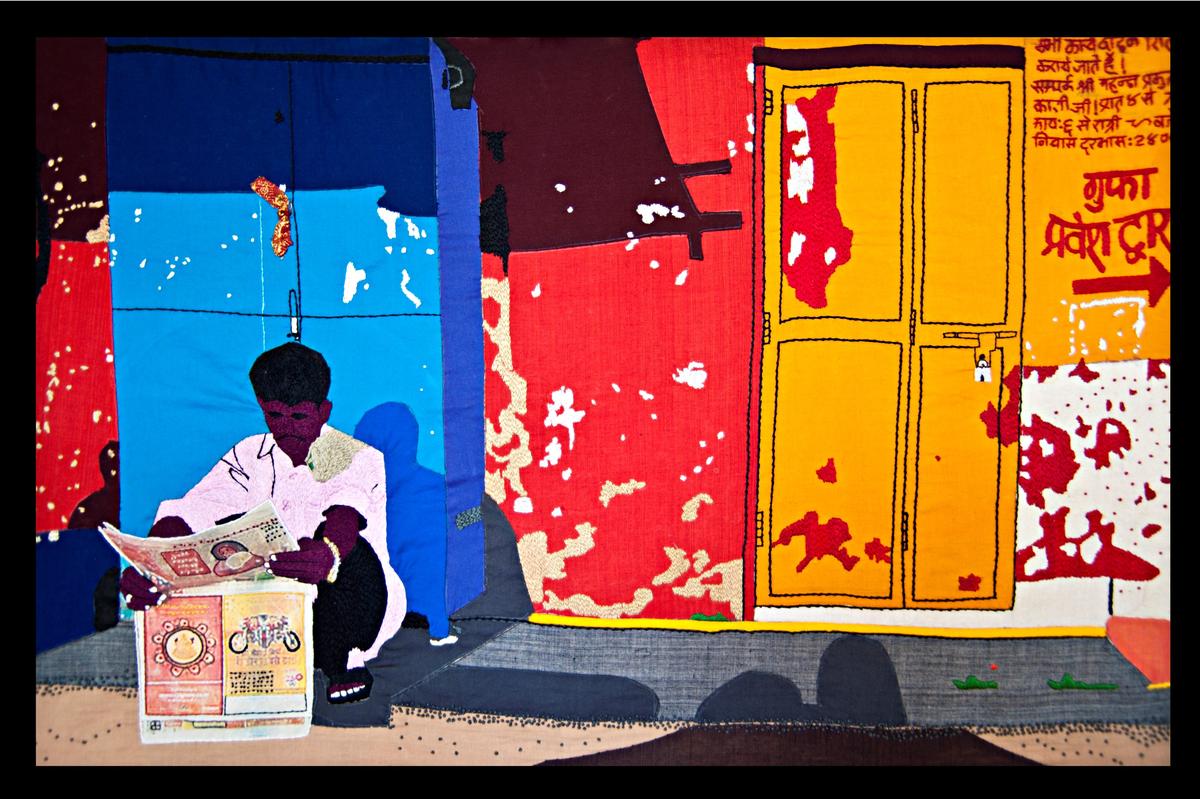
The subtlety of her process reflects the discipline she grew up observing. Nagarajan worked with film and believed deeply in analog photography. She recalls how she had a darkroom at home, where she developed her own negatives and printed her own photographs. When the digital age arrived, he decided to stop taking photographs altogether. For him, the commitment to craft, composition, time and patience, remains a constant reference point.
There is also a separate series called Banaras, along with works taken directly from his father’s photographs. Unlike the paired pieces in the main tribute, these compositions are based not on his images but on his own visual memory of the city. For him, Varanasi was never a distant pilgrimage site. This was a recurring scenario of childhood. “My father used to take us to Varanasi because he was doing a feature on Varanasi and I have vivid memories of our time there,” she says. The ghats, the colorful walls, the women sitting in groups stayed with her.
”I would like people to go back with the feeling that it existed,” she says.” In choosing images of everyday life, moments that might otherwise slip into obscurity, Kalyani hopes to preserve not only her father’s collection, but also a visual history of an India that feels increasingly distant.
For an artist who has long used her practice to foreground larger concerns, from climate change to endangered species, Tribute to My Father feels both intimate and sweeping. It’s definitely a tribute to a daughter. But it is also an argument for taking a closer look at the neglected, the ordinary and the almost forgotten and recognizing their value.
Tribute to My Father will be on display at Lalit Kala Akademi till February 26.
published – February 17, 2026 05:35 PM IST