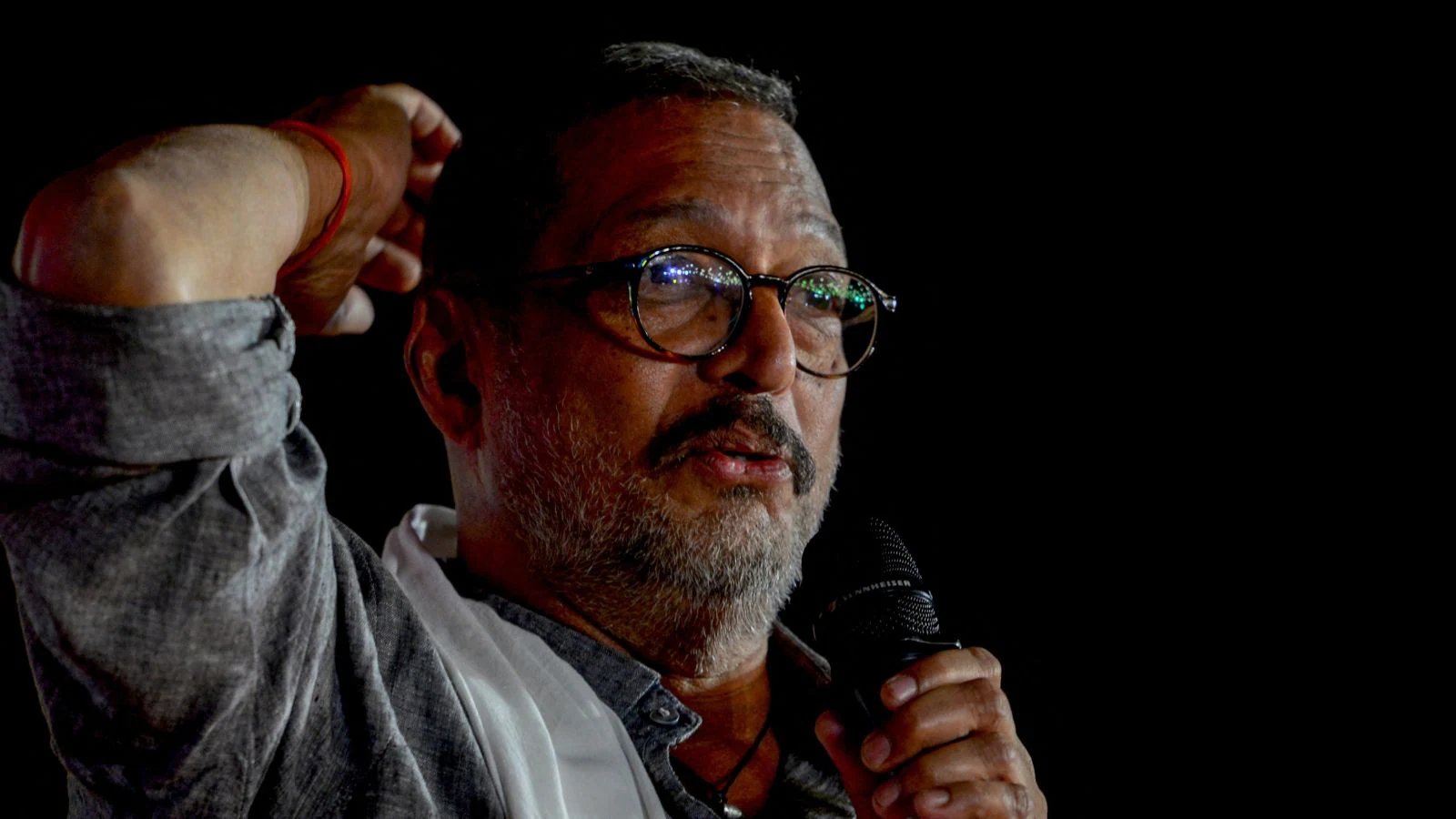
Nana Patekar died of a heart attack at the age of 75 at his residence in Goa. Actors who have mesmerized the audience time and again with their performances in films like Parinda, Krantivir, And Prahar faced great financial hardship early in life. He started working only at the age of 13.
After school, Nana Patekar used to walk 8 km to Chunabhatti to paint movie posters. The job paid him Rs 35 per month and included one meal a day. In an interview with Bombay Times in 2015, the actor spoke about those difficult years. However, he saw this period not only as a time of struggle. Instead, he credits those experiences with teaching him valuable lessons and shaping the person he has become.
He told Bombay Times that Economic Times, “When I was just 13 years old, we went from middle class to lower middle class and finally to lower class, as someone close to my father took away everything, including his property. Suddenly, I started working at the age of 13. After school, I would walk 8 km to Chunabhatti to paint movie posters to earn Rs 35 per month.”
Recalling that period of struggle, she also said, “I was in class nine but that humiliation and hunger taught me so much that I didn’t need to go to an acting school. I had to support my family because my father had lost everything.”
“I’d go over to a friend’s house at lunch or dinner and say, ‘Hi. Hi. How are you?’ Hopefully he can ask me and insist on having bread with me,” said Nana Patekar.
Over time, Nana Patekar made a name for himself in the film industry, but he stayed away from an extravagant lifestyle. He enjoyed cooking and often prepared his own meals.
He also spoke about preferring life on his farm to the glamor associated with the film industry. He reportedly owned a modest 750 square feet, one-bedroom apartment in Andheri, which he bought for around Rs 1.1 lakh a decade ago. In his later years, he spent most of his time at his home in Goa and at his farmhouse in Doneje, on the outskirts of Pune.
Screenwriter Ranbir Pushap once recalled that Nana Patekar decided not to buy a luxury car worth around Rs 1.5 crore and instead decided to use the money to help families affected by farmer suicides.
Nana Patekar was also involved in initiatives for the welfare of farmers. He co-founded the Naam Foundation to support farmers and rural communities.
Speaking on Siddharth Kannan’s podcast, Ranbir Pushap said, “One day he was watching the news and saw families grieving after many farmers committed suicide. The next day he was supposed to buy a car worth Rs 1.5 crore, but instead he called his artist friend and told him that he could make a check of Rs 15,000 and distribute it to the farmers’ families. Formed the Naam Foundation, which till date has raised countless funds.”
Nana Patekar also spoke about his financial struggles during an appearance on Kaun Banega Crorepati. The host Amitabh Bachchan asked him, “Are you an alumnus of the JJ School of Arts?” [Are you an alumnus of the JJ School of Arts?]
Nana Patekar replied, “I did commercial art from my vehicle. Then in the advertising agency we imagine. And after that, do you have to pretend to get the job? So we chose the job. And then he continued doing theatre. At that time Amitji had said this. “It’s weird.”
[Yes, I studied Commercial Art there. Then I worked as a visualiser at an advertising agency. After that, I had to choose between doing theatre and keeping my job. So, I left the job and continued doing theatre. At that time, Amit ji, there was hardship. There was poverty.]
He added, “Tuh hamare jo deen sahab de, hanmante, wu hamen kam dete-sarkar ke parivar niyojan ye koi bhi…’dhumarpan mat karo’, ‘ye karo’-such posters, then wo hamen…kam dete. Then money is received from him.”
“Once we also got help, it was a zebra crossing, we painted, we got 15 rupees. So it was fun to talk, we didn’t extend our hands to anyone. Whatever work we did, we kept doing it. Food came to us… money left in the pocket. We wrapped it in newspaper and made chapatis, rotis. And we put it in our pocket… This is how you are living and in your pocket.”
“And then we get a normal 15-paise meal. And if we get a five-paise meal, we get a 10-paise meal, so we had to live on 25 paise. A lot of girls, when they have money, they have to go to Empire, go to Regal, watch movies … that’s their homework. To ‘yes,’ to uske mein kabhi bhajiya mein, kabhi bhajiya.” Tha, sometimes coffee pilates, sometimes brushing.”
[Our dean, Hanmante sir, would give us work. These would be government posters about family planning or messages such as ‘Don’t smoke’ and other public-awareness campaigns. We would earn some money from that work.]
[Sometimes, we also got work painting zebra crossings, for which we were paid Rs 15. The good thing was that I never had to hold out my hand and ask anyone for money. I took up whatever work came my way. I used to have four annas as pocket money. I would carry chapatis or rotis wrapped in newspaper and keep them in the pocket of my kurta. I used to wear just a kurta and pyjama.]
[With four annas, I could buy usal (traditional legume curry) for 15 paise and two bananas for 10 paise. So, I managed on 25 paise. There were several girls from well-off families who wanted to go to places such as Empire or Regal to watch films. They would ask me, ‘Oh Nana, will you do my homework?’ I would say yes, and in return, they would sometimes buy me bhajiyas or coffee, or give me brushes.]
During the show, Nana Patekar also talked about his father’s financial crisis. Amitabh Bachchan asked him, “And what are our computers saying that you can paint posters like this too?”[And our computer tells us that you also used to paint posters and similar things?]
Nana Patekar replied, “We were in the same class. And our father had a business, among us… someone took the wrong signal and took it all away. So we started working. So we came from school… at 1:30. There is a lot of food, we have to drive 8 km, we have to drive 8 km – 16 km a day. And there were all the cinema letters. I used to get 35 rupees a month… and an hour’s bread.
“When I eat in the evening, I think – mother won’t eat, father won’t eat, brother won’t eat. But where I eat, I eat… because the world is so big, this thought doesn’t stay in the mind afterwards.”
Amitabh Bachchan: You are an alumnus of JJ School of Arts. Nana Patekar: Yes, I studied commercial art there. After that, I worked in an advertising agency. I had to choose between doing theater and having a job, so I quit my job and started doing theatre. We were also struggling financially. Our dean used to give us work to help us earn a living… Sony TV: KBC Clip
— Arun K. Yadav (@Arun73326698) October 8, 2026
“But what we’ve taught every day has worked wonders. We can’t study in a school-college.”
[I was in Class IX. Someone got my father to sign something related to his business under false pretences, and we lost everything. So, I started working. I would return from school at around 1.30 pm, eat something and then walk eight kilometres to work and eight kilometres back, covering 16 kilometres a day. There were film posters there, and I was given the job of filling in the lettering. I earned Rs 35 a month and received one meal a day.]
[While eating in the evening, I would wonder whether my mother, father, and brother had eaten. But the thought would end there and I would finish my meal because the hunger was so overwhelming that, after a point, I could not think about anything else.]
[But what those days taught me was extraordinary. Those are lessons you cannot learn in any school or college.]
Coming back to Nana Patekar’s death, according to hospital sources, doctors tried to revive him for about 45 minutes, but there was no response. The actor was declared dead on October 8 at 5.20 am.
Also Read: Tanushree Dutta on Nana Patekar’s death: “Once I find out I will give my reaction…”