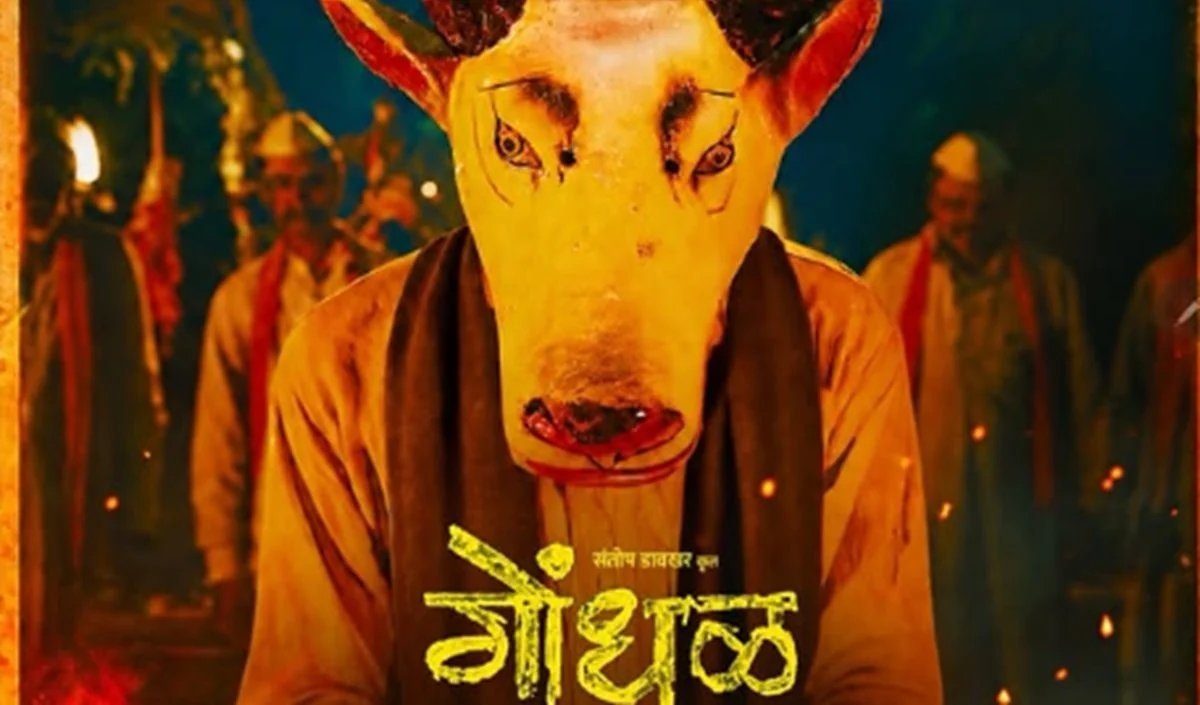
There is always a different charm and thrill in those stories, which take place in just one night. It has a grand wedding one night, a traditional folk performance from Maharashtra, some complex human relationships and rural characters full of secrets, and all the elements required for a taut thriller. Santosh Davkhar’s Marathi film ‘Gandhal’, selected as India’s official entry for the 99th Academy Awards (Oscars), tries to weave all these elements into a story that questions human desires as well as the structure of society that controls these desires. Set against the backdrop of traditional ‘Gondhal’ customs prevalent in rural Maharashtra, this psychological thriller explores serious themes of desire, patriarchy, caste system, dowry system and abuse of power. Its stunning cinematography and rich cultural milieu make it very interesting initially, but due to the weak and fragmented screenplay, it falls short of being a memorable thriller.
Movie Name: Gondal
Director: Santosh Dwakhar
Cast: Ishita Deshmukh, Kishore Kadam, Suresh Vishwakarma, Yogesh Sohoni, Anuj Prabhu, Nishad Bhoir, Dhruv Thoke
Music: Iliyaraja
Cinematography: Amlendu Chaudhary
Rating: ★★★☆☆ (3/5 stars)
‘Gondhal’: A wedding, a ritual and many hidden agendas
The film takes a long time to introduce the characters and establish the social fabric of the village. Initially, Suman was to be married to Sarjerao (Nishad Bhoir), the son of the influential village head Abasahib (Suresh Vishwakarma). But this relationship does not end due to her family’s demand for dowry, after which Suman’s parents get her married to Anand. What makes this situation most interesting is that Suman has no choice about her future. She may have the courage to pursue the man she loves, but when it comes to marriage, her own desires take a back seat. This contradiction becomes one of the main conflicts of the film.
Also, Aaba Sahib’s influence on the village adds another layer to the story. He is a man who lives in fear and uses his position to exploit those around him. Her son has his own ambitions, while the other characters pursue their own personal interests. The film slowly weaves these parallel stories together and the ‘dirty’ event becomes a witness to many bitter truths. It is not just a celebration of marriage, but a place where power, desires and resentments come out into the open.
Gondal: The technological experiment works, but only to a certain extent.
The biggest strength of ‘Gandhale’ is its cinematography. The film opens with a single-shot sequence of about 25 minutes, showing Bhiwaba (Kishore Kadam) and his grandson Vishnu (Dhruv Thoke) heading towards a village celebration. The scene, shot by Amlendu Chaudhary, introduces us to the characters without resorting to conventional cuts. The camera moves through the village—capturing conversations, passing vehicles and everyday conversations, revealing the power equations of the village. It’s an interesting way to introduce us to the world of the film, and the patience with which the series progresses is admirable. This single-shot technique brings a kind of immersion to the film.
Instead of seeing the village from a distance, the audience is able to feel its atmosphere and slowly begin to understand the people who live there. However, this technique eventually becomes more of a talking point than a storytelling tool. Once a film establishes its visual identity, that connection to the story doesn’t always last. The subsequent decision to abandon the single-shot format has also raised questions about whether the experiment could have been used more consistently. A technical achievement is certainly admirable, but it should be part of the story, not the story itself.
Gandal: Acting kept the drama as a basis
Ishita Deshmukh is the biggest asset of this film. In the role of ‘Suman’, she plays a woman who is troubled by the circumstances imposed on her, but also determined to find a way out of them. There is a kind of rawness in his acting, which suits the character and atmosphere of the film. Kishore Kadam brings experience and credibility to the character of ‘Bheeba’, while Suresh Vishwakarma brings an intimidating personality as ‘Aaba Sahib’. His character represents a local ruler whose influence is based on fear rather than respect. Nishad Bhoir has also made his presence felt as ‘Sarjerao’. Yogesh Sohoni and Anuj Prabhu drive the main conflict of the story, though the emotional relationships between these characters could have been developed better. There are many faces in the supporting cast that may be new to the audience, but they reinforce the realistic feel of the film.
There is a kind of unpolished quality to the acting, which actually works in the film’s favour. The characters do not seem ‘rote’ or ‘rehearsed’ anywhere, due to which the authenticity of the rural setting remains intact.
Gondhal: Ilayaraja’s music adds cultural depth Another major reason why ‘Gondhal’ stands out is its association with legendary composer Ilayaraja. His music gives the film a distinct identity; Especially the song ‘Chandana’ sung by Ajay adds a very fun touch to the film. The performance of ‘Gandhala’ itself is an interesting part of the story. For viewers who are not familiar with this tradition, the film offers a glimpse into a folk tradition of Maharashtra that has cultural and religious significance. Colorful performances, music and rituals create a visual contrast between the serious and dark events taking place in the film.
However, the film could have integrated this cultural element into its main story more meaningfully. At many places the performance of ‘Gandhale’ runs alongside the main play but does not contribute much to the story. Since this ritual features so prominently in the film’s title and setting, it is expected that it will have some deep connection to the characters and their journey. The cinematography, sound design, and editing combine to create a great technical aspect, even if the screenplay doesn’t always take full advantage of these elements.
Where does ‘confusion’ go wrong?
The biggest problem with ‘mess’ is that it tries to fit too many ideas at once. It wants to be a psychological thriller, a commentary on rural power structures and a showcase of Maharashtra’s folk heritage – all at the same time. While these themes may overlap, the writing doesn’t always strike the right balance. The film touches on issues like caste, class, patriarchy, sexual harassment and abuse of power. These are important topics today, and the story does credit for not shying away from harsh truths. However, some of these issues feel like they’re slapped on top of an already packed story, rather than adding to the story naturally.
The characters are also not always created with the same depth. For example, Aaba Sahib is shown as a very cruel and powerful person, but the script does not focus on any aspect of him other than his villainous nature. Similarly, many events occur in the story, not giving the audience enough time to understand their emotional consequences. The last part of the film is the weakest. As the story takes turns and the violence escalates, the story begins to lose its emotional grip. Events that should have had a profound effect pass by without leaving any significant impact. A thriller film can shock the audience, but it must also make the audience sympathize with its characters. ‘Gandhala’ seems to be struggling to maintain this emotional connection.
Final Verdict: To Watch or Not To Watch?
Santosh Dakhar certainly deserves appreciation for his attempt to create an offbeat and ambitious cinema through ‘Gandhal’. Being India’s official Oscar entry, the film has got a huge global platform, which is a point of pride for Marathi cinema. If you are fond of stunning cinematography, Ilayaraja’s music and glimpses of Maharashtra’s folk culture, then you can give this film a chance. However, viewers expecting a taut and emotionally satisfying thriller may find the film a bit underwhelming.