London is a city where it is impossible not to be attracted by the thousands of fascinating activities – theatre, film, seminars, symposia. I am on a short trip. But every evening some program seems unique. The British Film Institute had a great documentary nazaBy Yuval Abraham and Rachel Szor, which talks about the internalized hatred carried out by the Israeli state on civilians in Gaza.
According to scholar David Shulman, known to Indian readers, the name comes from the Hebrew acronym for the word executable. nezek agawiWhich means “collateral damage.” Mr. Shulman points to one particular tradition: “Ashkenazi Jews have an unwritten rule that no one should tell goyim about Jewish misdeeds. There is a name in the Jewish language for someone who does this: the despised moyser, the informer.” It gives an idea of the high price society has to pay for speaking truth to power, which is the core of the documentary.
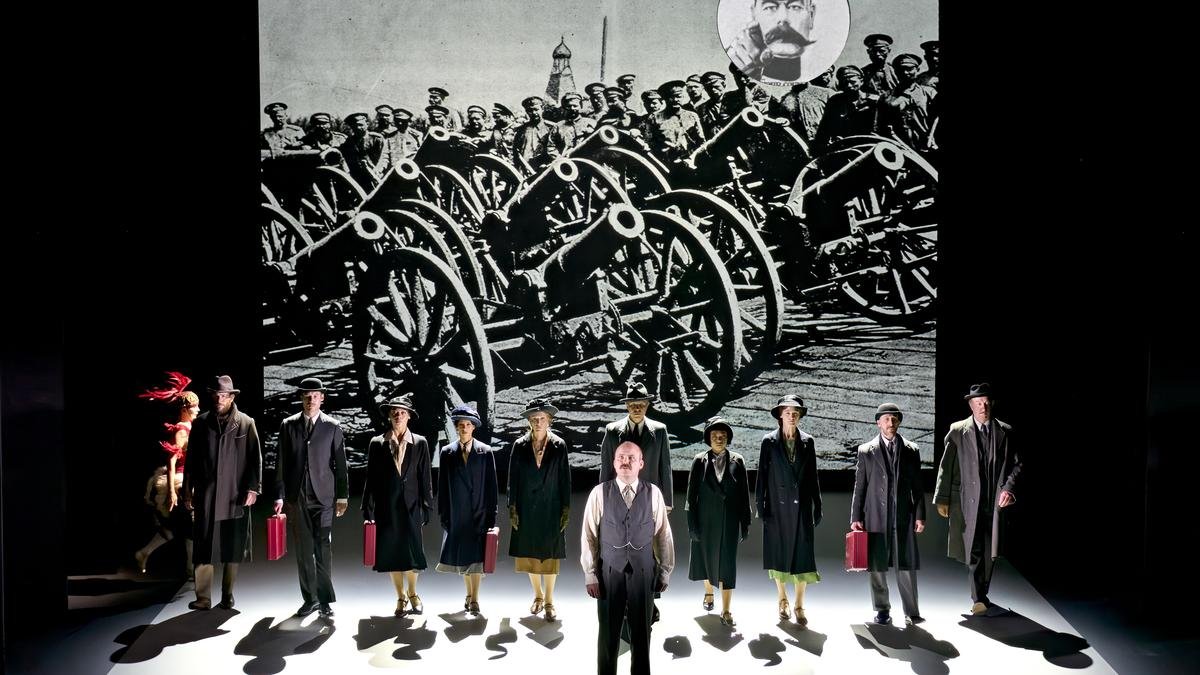
The London West End world premiere took place before anyone could produce a powerful documentary Quality of life. Just over four decades in journalism made me take editorial and editing seriously Guardian That said, James Graham’s latest play has captured the zeitgeist, considering the play reflects both the emotional and intellectual passion of John Maynard Keynes – compelling me – first to watch the play and second to write about it for Indian readers. Guardian The editorial and its lengthy review by Arifa Akbar provided readers with the context to understand the war and post-war years intuitively. As Arifa Akbar points out, “John Maynard Keynes (Rory Kinnear) may not have cut a very bohemian picture in his three-piece suits, but Britain’s leading thinker of economic policy in the 20th century was also a card-carrying art lover, avant-gardist and bisexual, who had connections with Lytton Strachey and Duncan Grant, who hung out with the gang at their nerve-centre in Charleston. He Played with equal amounts of old-school reserve, and charm, by Kinnear, as the nation’s state writer, James Graham, boldly brings economic theory to the West End.
capturing the human spirit
We rarely understand that economic theories from Adam Smith to Karl Marx derive their driving force from life experience. The play begins with a fundamental question posed by Keynes: “What would the good life look like for you? And can that life, a life that is rich and full, be quantified and measured: are there any equations and formulas for it?”
The dialogues throughout the play reflect the human spirit of restoring a sense of hope and stability lost during the war years. This makes it clear that economics is a social science for humanity and not a knowledge for faceless entities like markets, nation states and security apparatuses. In the play, Keynes claimed that economics is not just a science but a moral science. He says: “It involves value judgments about how we can live better together. If that’s not it – then it’s nothing.”
The relationship between a sensitive economist invited by the state as its advisor and a permanent bureaucracy is a difficult exercise. From Ashok Mitra to Jean Dreze, there are many Indian examples. The takeaway from the play is that the gap between those who represent the cognitive aspect of economics and those who manage economics is a constant erosion, and it would be foolish to want to overcome it. Economics as a public good and economics as a management tool join together to give economic administration. The play depicts this deep mutual hostility in a sophisticated and subtle way, without creating an arena or gladiatorial game.
The play deals with several controversial issues that lead to policy paralysis due to differing viewpoints. ditch of laissez-faire Kalpana is very deep and has religious fever.
After all, Keynes is not a socialist economist, but rather a man who understood the limitations of the market and supported it. If we summarize his view, economics requires markets and adequate state intervention to keep the economy running. The ideological battle between Keynes and Friedrich Hayek, the Austrian economist who became famous in Western Europe, gives an idea of the difficult task facing any economic adviser who wishes to propose any idea that could control markets even for a short period of time.
The best part of the play is that these controversial issues are presented not as controversies but as lived experience – as a human encounter with the world in which people want to live with a certain amount of comfort and certainty.
multiple topics
Love, domestic disharmony, the pressures of bi-sexuality, the radical emergence of feminism, women’s voices getting their fair share in the public sphere, writer Virginia Woolf’s rise to star status, continent-wide fame for ballet dancer Lidia Lopokova (her presence in Keynes’s life forces him to abandon his homosexual love and become heterosexual), access not only to power but also to the cultural life of London, among the prescriptive for being The ups and downs give the play a human touch rather than being an economics class for bisexual, graduate students. Keynes’s question becomes universal as well as human: “Can you put a price on happiness, beauty and love?”
Games often teach us more than textbooks. For example, Dara Shikoh, A play by Gopal Gandhi helped us understand brotherly violence in our region. When Sri Lankan Tamil militant groups turned their guns on each other, this is what happened Dara Shikoh Which showed the poignancy of the loss. Quality of life Made me think of an Indian version: a play on Amartya Sen. The Nobel laureate has already written a rich autobiography, home in the worldand has been the subject of countless interviews and profiles.
His life experiences and intellectual experiences reflect so much of the contemporary history of the subcontinent, that I am sure the play could be more condensed than James Graham’s poignant portrait of Keynes.
(AS Panneerselvan is director general of the Chennai Institute of Journalism)
published – November 26, 2026 08:30 AM IST