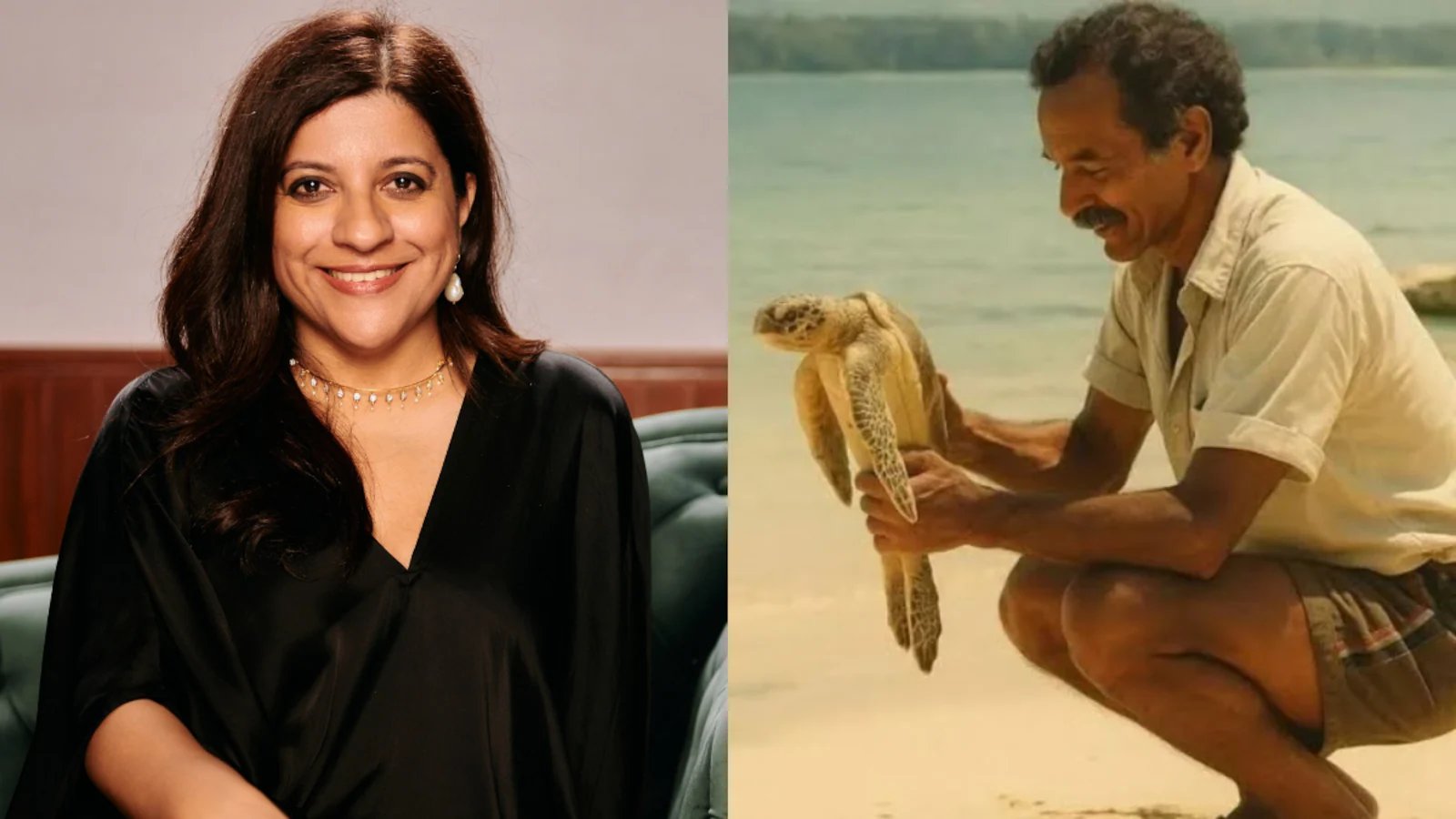
Filmmaker Tyra Malone had a small dream, and it took seven years for it to come to life before her eyes. Marking his feature-length debut, the 35-year-old director embarks on a journey to tell the story of Satish Bhaskar, a leading Indian marine biologist and conservationist, widely respected as a fundamental pioneer of sea turtle biology and conservation in India.
And so came his 75-minute feature documentary that tells the extraordinary story of this legend, who spent years walking thousands of kilometers along India’s coastline with the sole purpose of saving endangered sea turtles, documenting nesting sites along India’s coastline and the Andaman and Nicobar Islands.
In an exclusive chat with NDTV, director Taira Malone, co-producer Zoya Akhtar under her banner Tiger Baby, and Sai Abhishek (Head of Factual Entertainment, Lifestyle & Kids, South Asia, Skydance) revisited the many stories they had while making the project. The team conducted extensive interviews, and the documentary also includes key conversations and material from Satish Bhaskar’s personal archive. Unfortunately he died in 2023 and didn’t get to see the final premiere.
Among many anecdotes, a particularly romantic folklore incident from his life occurred in 1982 on the uninhabited island of Suheli Atoll (Suheli Par) in Lakshadweep. It is called the ‘message-in-a-bottle’ story, when Satish Bhaskar was stranded on the island for months. He missed his wife Brenda dearly and wanted to connect with her, and this is where the ‘magic’ happened.
He put the letters in bottles and threw them out into the sea. In a miraculous turn of events, one of those bottles ended up 800 kilometers away in Sri Lanka, where a fisherman found it and sent it to Brenda.
The bottling traveled 800 km, taking 24-26 days to finally reach Sri Lanka.
There can be no more powerful story of revelation, as Zoya Akhtar says.
This and more, as the creators and producers of Turtle Walker open up about their emotional documentary in a freewheeling conversation.
Q: Satish Bhaskar’s life often feels stranger than fiction. Was there a moment while recreating his journey when you felt people wouldn’t believe it actually happened?
Tyra Maloney: Yes of course. I think that was partly the draw of this story. So many of these events almost feel too hard to believe. They feel like fiction. Two moments stood out to me. There was a letter in a bottle. Satish was stranded for five months, and the letter traveled nearly 800 km to reach Sri Lanka. A fisherman found it and actually sent it to his wife. Stories like this feel straightforward Robinson Crusoe or throwing, Yet they are completely real. The second was when he had to eat turtle eggs because he couldn’t find any other food to survive on the islands. Both of those scenes were hard for viewers to digest because I had a hard time even believing that it actually happened.
Q: The stories you usually bring to life, when you heard about this message-in-a-bottle story, did it feel like a movie plot rather than a real-life survival story?
Zoya Akhtar: I didn’t immediately think of a movie. You had in mind the stories you heard as a child about people putting messages in bottles and sending them out into the world. You will see them as souvenirs, and they always have a sense of romance and wonder. When I saw this story, I didn’t know anything about it beforehand. What impressed me was that if you do something from the heart, it finds its destination. It’s almost like you express it. And, of course, kudos to the Sri Lankan fishermen who found the message and passed it on. So I didn’t think about movies as much as I thought about magic.
Q: Wildlife stories rarely become mainstream conversation pieces. What made Animal Planet believable? Turtle Walker Can connect with audiences beyond nature lovers?
Sai Abhishek: At Animal Planet, our aim has always been to foreground wildlife and the stories that surround it. Often, wildlife can become almost wallpaper-like. People get used to seeing the same images of chases and murders and become desensitized over time. When we saw Taira’s work, we felt it was an incredible and meditative take on Satish Bhaskar’s life. We often focus on lions, tigers, rhinos and other well-known species, but there are many creatures that are not well documented. This story needs to be told. It is also told in a very cinematic way and almost feels like a feature film. We felt the audience needed to see it. It also aligns with our strategy around “Epic Wild Stories”, where we focus on extraordinary stories from Indian filmmakers and the natural world. Turtle Walker is part of that franchise.
Q: You spent seven to nine years shaping this story. What part still bothers you?
Tyra Maloney: Our experience with Satish back on the islands haunts me. Our goal was simply to follow him and document what he experienced. He chose to return to South Reef Island, one of the most important nesting sites for hawksbill turtles that he discovered. We expected to find many turtle nests there. Instead, we got the opposite. Coral reefs were exposed, making it impossible for turtles to climb onto nesting beaches. What was once one of the most important nesting sites now contained no nests. Satish himself surveyed and found none. Seeing him act out that reality was devastating. He was very impressed, and so were we. This forced us to ask what might have happened to other nesting sites if such an important site had changed so dramatically.
Q: What part of the documentary felt deeply human to you?
Zoya Akhtar: For me it is Satish’s humility, kindness and gentleness. He truly believed that we share this planet and need to take care of it. What struck me was that a very quiet man made such a big impact and didn’t seem to care if anyone knew about it. This feels especially relevant today. Every living being exists for a reason. We share this world with them and they are needed here. We can already see the consequences of neglect through natural disasters happening around us. The planet is a gift, and we need to take care of it.
Sai Abhishek: This is the dedication of a man who spent nearly two decades believing in him. He went to extraordinary lengths to uncover the truth and remained committed to the mission throughout his life. To me, it represents the pinnacle of dedication and excellence. Another aspect that really resonated with me was the tender love story between him and his wife. These are the two broad emotional pillars of the documentary.
Q: With climate change and biodiversity dominating global conversations, how distressed was Satish Bhaskar by what was happening?
Tyra Maloney: When I first contacted Satish, he had largely distanced himself from sea turtle research and conservation despite devoting his life to it. Initially, I thought it was because of her physical condition, but I later realized it was emotional as well. He was very sad to hear what was happening and felt that he could not do anything about it. There was certainly a lot of sadness and pain. What became beautiful in the story was that he eventually joined the young researchers and learned that many people were continuing the work. He noticed that turtles were still returning to the nest and rescue efforts were ongoing. It gave him hope. He realized that the responsibility no longer rested solely on his shoulders. His legacy inspired others to carry on this work. It reminded him that while there are many challenges, nature is resilient and recovery is possible.
Q: Why was Satish made bigger than many of the fictional heroes we admire?
Zoya Akhtar: Fictional heroes are fictional. He was real. That is the biggest difference. He saved a species. This is unusual. He has long been an unsung pioneer, and this documentary is a wonderful way for others to understand the enormous work he did. I think we need to give these stories more platforms. We need to educate the younger generation because they are going to inherit this earth. Channels, producers and funding bodies need to invest in bringing these stories to the audience. Governments can also help, as this work is invaluable. What we’ve learned through screening is that people respond to these stories. The problem is not a lack of interest. The stories do not reach them. They need to be introduced.
Q: The documentary has traveled to major film festivals around the world. Did the answer overwhelm you?
Tyra Maloney: Definitely in the beginning.
Zoya Akhtar: And then you get used to it!
Tyra Maloney: You get used to it, but it’s important to remember the purpose. The film was never just for film festival audiences or filmmakers. Of course, their voices matter because they help the film reach a wider audience. But our ultimate goal has always been to reach the youth across India, including those who have never seen a sea turtle or explored a coral reef. This is the audience we wanted to connect with, and the festival tour was just one step towards that larger goal.
Turtle Walker is part of India: Epic Wild Stories collection and was released on October 19, 2026 on Animal Planet.