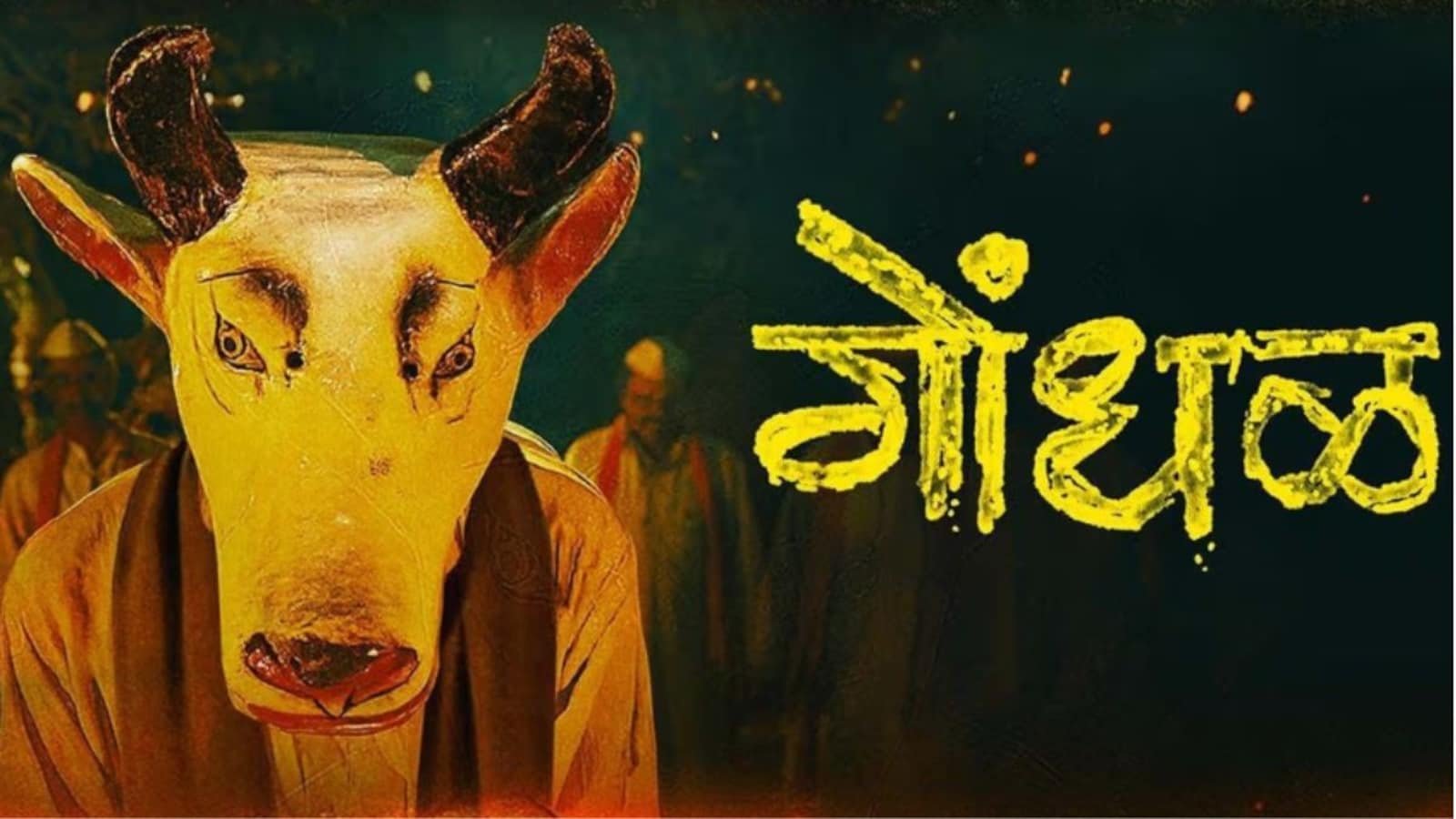
To have a certain appearance beauty knotted which makes it difficult to look away from the screen. Set against the backdrop of a Maharashtrian village wedding, the film draws you into a world shaped by centuries-old customs, local power equations and deeply held societal beliefs. Its biggest achievements lie in its atmospheric storytelling, impressive cinematography and music by veteran composer Ilayaraja. However, despite its technical brilliance, the film doesn’t quite live up to the promise of its story.
Chosen as India’s official entry for the 99th Academy Awards, the Marathi film hit theaters today in its Hindi-dubbed version. Written, directed and produced by Santosh Davkhar, the film stars Ishita Deshmukh, Yogesh Sohoni, Kishore Kadam, Suresh Vishwakarma, Nishad Bhoir, Anuj Prabhu and Vitthal Kale. Cinematography is by Amlendu Chowdhury, while Ilayaraja has composed the music.
A wedding, a ceremony, and a night full of secrets
Set in a village in Maharashtra, knotted One appears during the night. A wedding is taking place at the home of an influential local man, and the traditional gondal ritual is an important part of the celebrations. What begins as a simple wedding gathering gradually takes a different turn as a series of events exposes the relationships, tensions and power struggles within the village.
For the uninitiated, Gondal is a centuries-old Maharashtrian folk tradition, a ceremonial performance involving music and storytelling, usually performed to invoke and honor family deities. The film uses this cultural setting to explore much more than traditional ritual. Underlying the festivities are questions of social hierarchy, village politics, customs and the position of women in a deeply patriarchal environment.
Where the film loses its grip
The biggest challenge with knotted It has speed. The film takes its time in establishing the atmosphere surrounding the village, its people and the wedding. While this attention to detail helps create an authentic setting, it also means that the central conflict takes some time to emerge. To a large extent, the audience is left to try to understand where the narrative is going and what it ultimately wants to say.
The film also demands a certain amount of patience from its audience. Those unfamiliar with rural Maharashtrian life or traditional village customs may find it difficult to connect with the action, especially if they prefer fast-paced narratives.
There’s also the question of how fresh the story feels. The opening setting creates anticipation for an unusual, rooted drama that offers a glimpse into a world rarely explored on screen. However, as the narrative progresses, it moves into familiar territory involving infidelity, betrayal and local influence politics. These are themes that Indian cinema and streaming platforms have explored many times before. Therapy may be rooted in a particular cultural setting, but the underlying conflicts don’t always feel particularly real.
A sequence involving a child is also hard to watch. While the filmmaker seems to be trying to highlight some of the uncomfortable realities of society, the way the incident is depicted feels unnecessarily unsettling. More importantly, the narrative does not adequately explore its emotional consequences for the child. It’s a subplot that could have been handled with more sensitivity and depth.
Meanwhile, there are moments in the climax that remind Rishabh Shetty KantaraEspecially the way it builds towards its finale.
Cinematography is the biggest winner of the film
If there is a department where knotted What really stands out, though, is the cinematography. Amlendu Chowdhury’s work is remarkable, especially considering the film’s dark atmosphere and limited light sources.
The village is depicted without electricity, and yet the frames are remarkable in detail. The lighting is so thoughtfully executed that many sequences appear almost naturally lit. The interplay of darkness, shadows and available light adds to the atmosphere of the film considerably.
Long-term use is another technical highlight. The opening sequence, which reportedly runs for about 25 minutes in a single take, is particularly impressive. Executing a shot of this length requires extraordinary coordination between camera movement, actors, dialogue delivery and blocking. It also demands extensive rehearsals and careful planning. The seamless execution reflects the efforts put in by Davkhar and Chowdhury.
Santosh Davkhar gets the right to the rural world
As a director, Santosh Davkhar deserves credit for creating a world that feels lived-in rather than created for the camera. From traditional artists brought to knotted Sequences of everyday interactions between relatives, the film captures the rhythms of rural life with considerable authenticity.
Small arguments, family dynamics, local behavior and the way people interact with each other lend a sense of realism. There are moments when the difference between watching a movie and watching a real village wedding almost disappears. This is a significant achievement.
The screenplay also deserves praise. It’s not easy to confine a story involving multiple characters and developments to one night and a relatively limited setting. Despite its pacing issues, the script manages to bring together several narrative threads while maintaining the film’s central atmosphere.
Ilayaraja’s music and powerful performance
Ilayaraja’s music is another great asset. Rather than feeling like an addition to the narrative, the compositions blend naturally into the film’s rural setting. A particular song stands out for its emotional quality and stays with you long after the sequence is over.
Performances are consistently convincing. Kishore Kadam and Ishita Deshmukh are particularly impressive, bringing considerable depth and naturalness to their respective characters. The ensemble cast contributes to the film’s authenticity, with performances that rarely feel theatrical or forced.
decision
knotted A technically proficient film that deserves praise for its visual storytelling and recreation of rural Maharashtra. Santosh Davkhar’s direction, Amlendu Chaudhary’s exceptional cinematography and Iliyaraja’s music make it a rewarding cinematic experience in many ways.
However, the slow narrative and familiar story elements keep it from being as compelling as it could have been. The film has atmosphere, craft and some great performances, but its storytelling needed a strong sense of innovation and immediacy.
Also Read | Marathi movie knotted beats Dhurandhar, Hanuman Part To be India’s 2027 Oscar entry