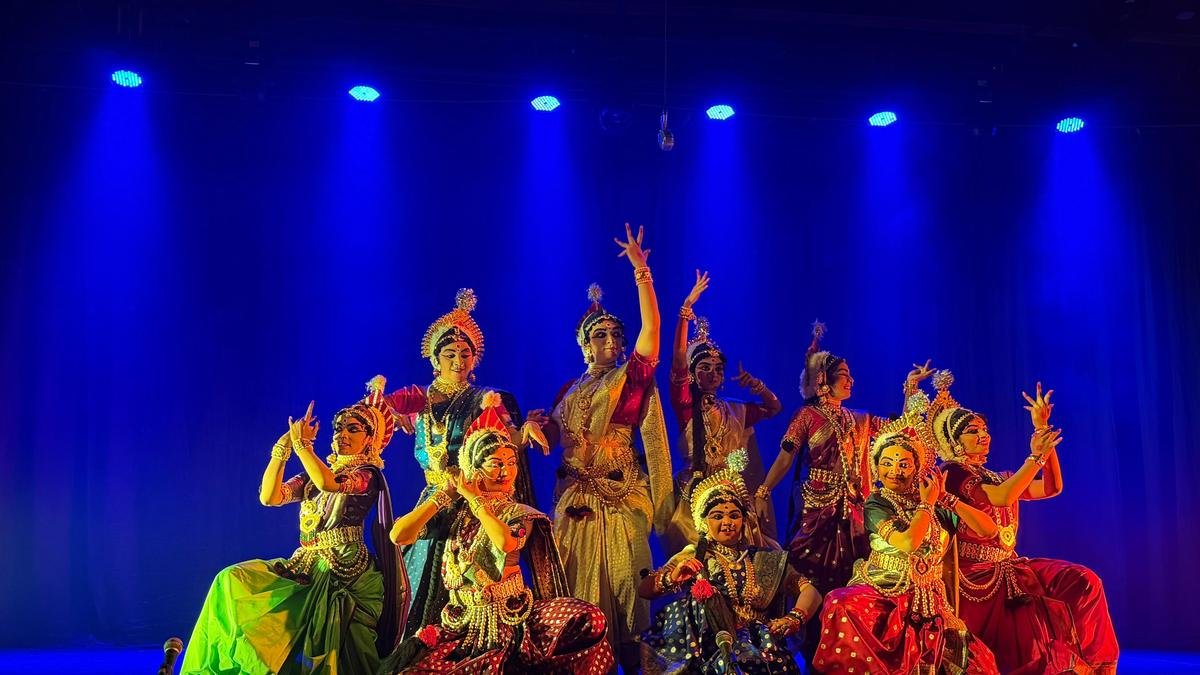
It’s 10 o’clock at night, and Qadri Jaathre (Fair) is going on in Mangaluru, Karnataka. There is a chill in the January air and people visit the more than 1,000-year-old illuminated Manjunath Temple, painted bright blue. Suddenly, an echo of the sound of the taal is heard – the night’s Yakshagana has begun. People take their seats as soon as the troupe of mainly women, headed by Sri Sai Kala Yaksha Balaga, Dr. Shivarama Karantha Balwana Puthur, Prema Kishore, begins the four-hour long Rati Kalyana performance.
A scene from ‘Devi Mahathameya Chanda Mundaru’ staged in Mysore by Sri Sai Kala Yaksha Balaga, Dr. Shivarama Karantha Balavana Puthur, a predominantly women-led troupe led by Prema Kishore. | Photo Credit: Special Arrangement
The voices reach their crescendo, the dancers jump and spin, and the people watch in fascination. The next morning, with their elaborate costumes packed and oil-based makeup washed off, they returned to the routine. They could be housewives, teachers, students and dancers, all of whom are attracted to Yakshagana because of its larger-than-life appeal and cultural connect.
This was not the case a few decades ago, when Yakshagana was a male bastion, and men also played female roles. Note banker, Yakshagana exponent and writer Krishna Prakash Ulithaya, women entered this field in the middle of the 19th century. “There is not much documentation, but there is a reference to Kibbachala Manjamma of Sagar in Shivamogga district, who lived from 1830 to 1900 and wrote four or five plays, including Sampoorna Mahitriya and Jeeva Parmar Kalyana. There is also a reference to Mahalakshmi Hebbara Chavadi, who wrote Kempasura Kalaga. But women have entered the performance field only recently,” he says.
Narmada Shibarurai was the first female bhagavat (singer), but she remained an amateur artiste. Lilavati Baipaditya was the first professional female artist, who started her career in 1970. Her husband Harinarayana Baipaditya, a senior Yakshagana percussionist, scholar and teacher, taught her Yakshagana singing, Ulithaya elaborates.
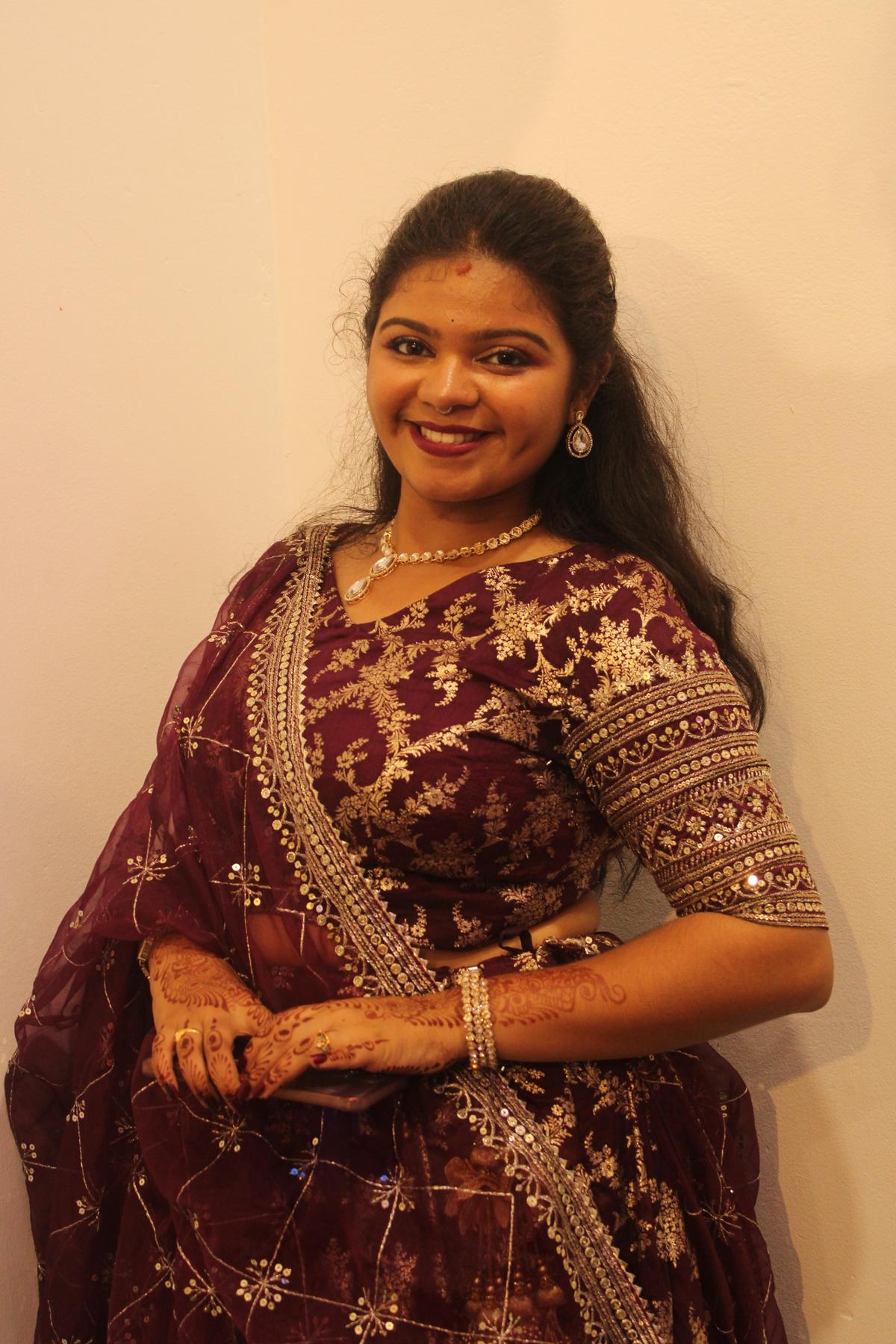
Sakshi Sheshadri, 20, is a final year business student at St. Aloysius, Mangaluru. A student of Sumangala Ratnakar Rao, she is also a Yakshagana artiste. | Photo Credit: Special Arrangement
Among the young emerging artists is Sakshi Sheshadri, 20, a final year business student at St. Aloysius, Mangaluru. She was barely three years old when she saw a performance of Yakshagana. In the evening, during the Yakshagana season (November–April), she dresses in heavy attire, paints her face with innumerable colors and performs Yakshagana. One day, he is a deity, the next day a demon, and the third, a dancer.
She says, “I remember artists coming to perform at our home in Kateel. Everyone thought a child would be scared by the exaggerated expressions. But I smiled brightly. My father Sheshadri P Bhatt decided that I would learn art.”
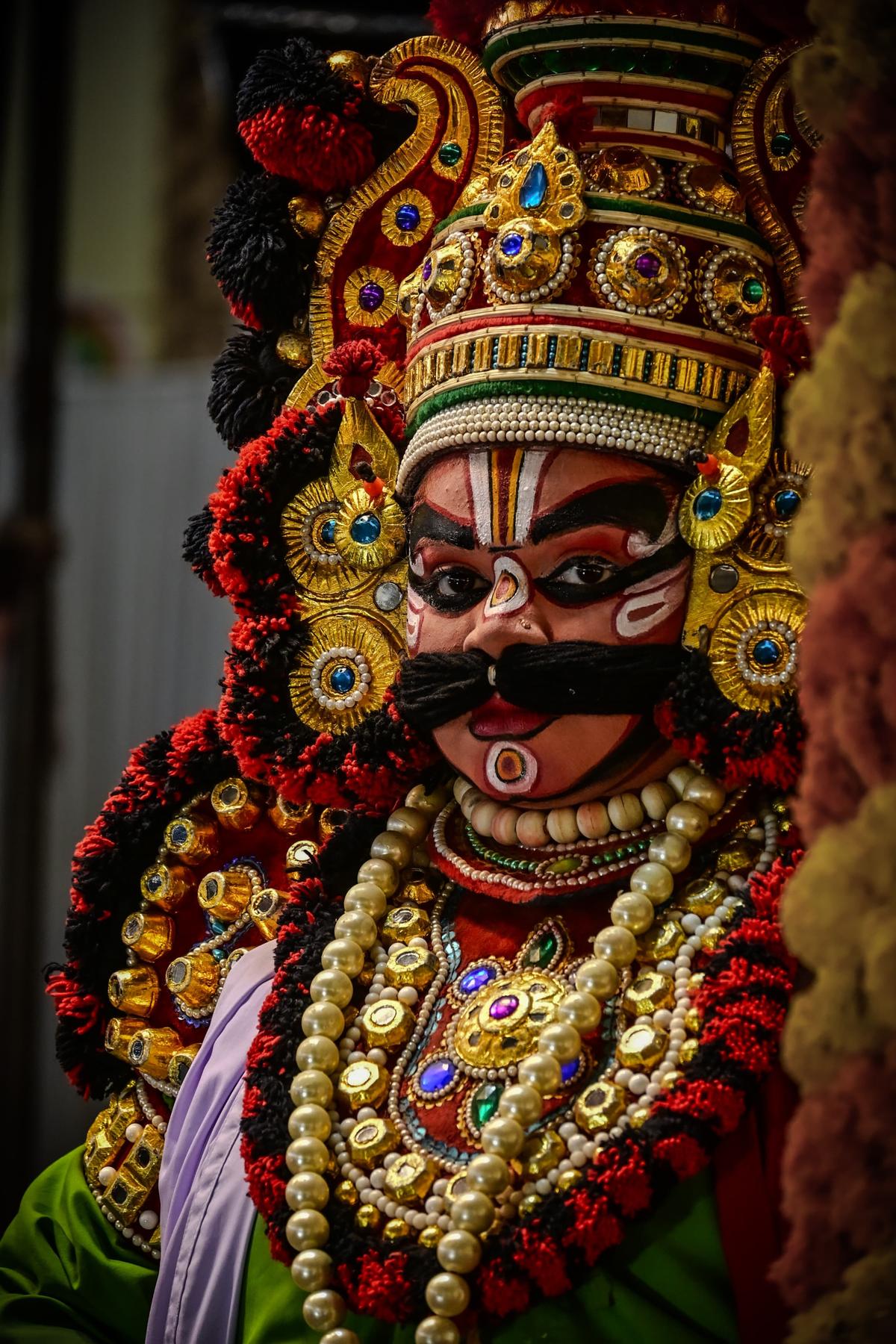
Sakshi Seshadri paints her face with innumerable colors and performs Yakshagana – on one day as a god, on the second day as an asura, and on the third day as a female dancer. | Photo Credit: Special Arrangement
He started learning in class 3. His first performance was opposite Goddess Durga Parameshwari in Kateel. In class six, she moved to Urwa in Mangaluru to learn under Sumangala Ratnakar Rao. “When I started learning, there was a mixture of excitement and fear. My Kannada was not very strong then and I had no dialogue. I learned with time.”
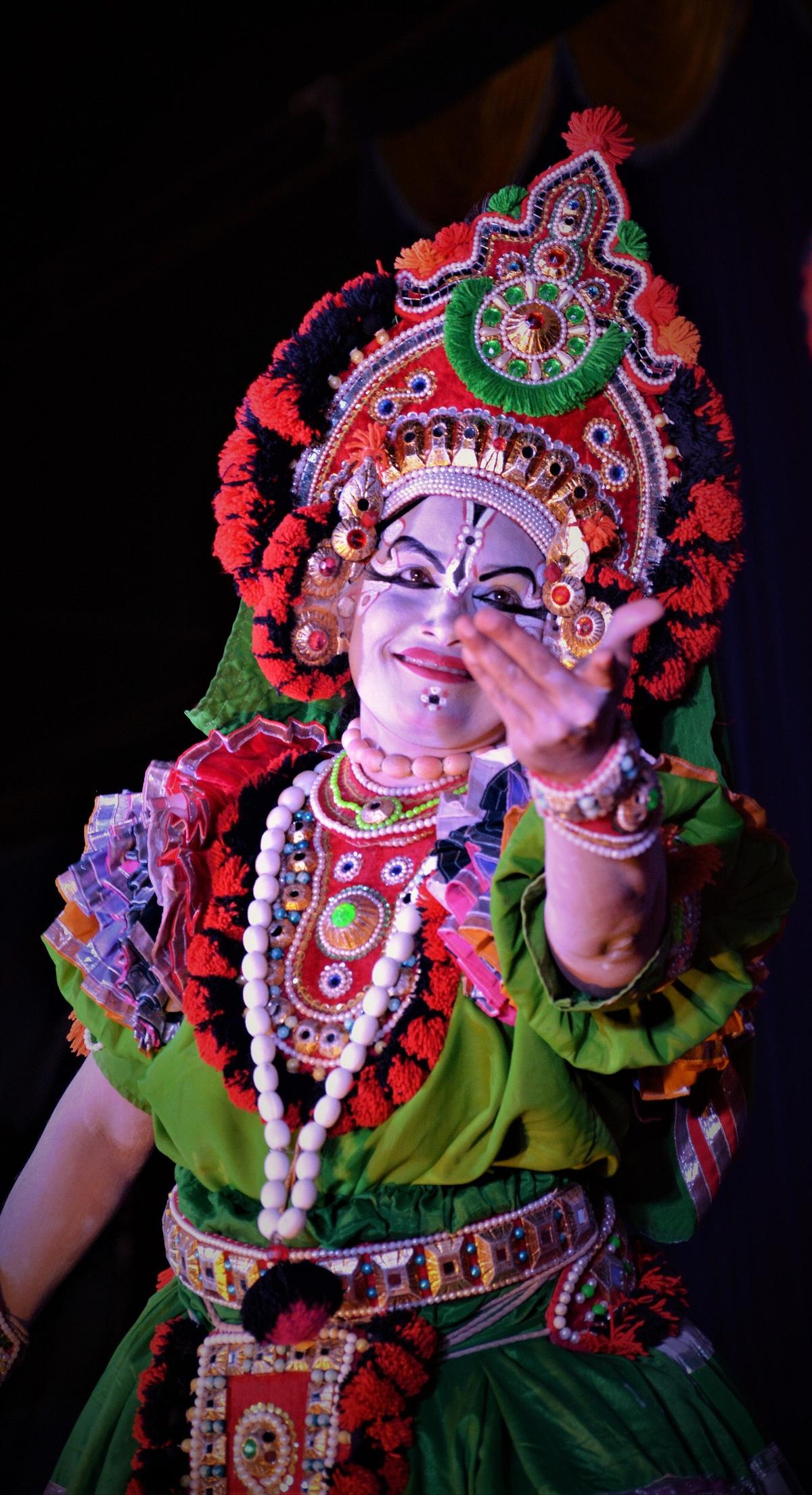
Aarti Patrame is an English teacher in Tunkuru, who performs Yakshagana and also teaches art. | Photo Credit: Special Arrangement
Aarti Patrame, 43, started learning while in school in Nidal near Dharamsthal. “I think I was attracted to the costumes. Not many women had learned this art then, and our school teacher Venkatesh Tulupule, who was an amateur artist, taught us the basics to dress up for the annual day. I played the role of Daksha.” Aarti later moved to Ujire and was mentored by artists Ashok Bhatt of Ujire and Surikumeru Govinda Bhatt. Aarti balanced her passion for Yakshagana with teaching English at Vidyanidhi PU College in Tumakuru. She trains students in Yakshagana at Yakshadivige along with her husband Padmanabha KV, who is an Associate Professor at Tumkur University. He recently visited Bhutan on a project given by the India Bhutan Foundation for a comparative study on the mask dances of Bhutan and Yakshagana of India.
51-year-old Purnima Yatisha Rai has been performing Yakshagana since the age of 14. He debuted in 1988 with a show called Punyakoti, the story of the honest cow who went back to surrender herself to the hungry tiger. “I was supported by my brother Madhav Shetty Bana, and I learned from gurus Shivaram Panambur and Ramesh Shetty Bayaru.” Her troupe Sri Mahaganapatha Mahila Yakshangana Sangha in Bala Katipalla near Mangaluru has performed over 1,500 performances across the country and in Dubai, some of them overnight.
“Sridhar Aithal, a banker, was the first person to teach Thenkutittu (Southern style) Yakshangana to women,” says Sumangala, 49, a trained Bharatanatyam artiste. He started learning Yakshagana from Yakshagana artist Rakesh Rai Adka in 2009 at the age of 32. His first performance was Krishnarjuna Kalaga, where he played the role of Arjuna.
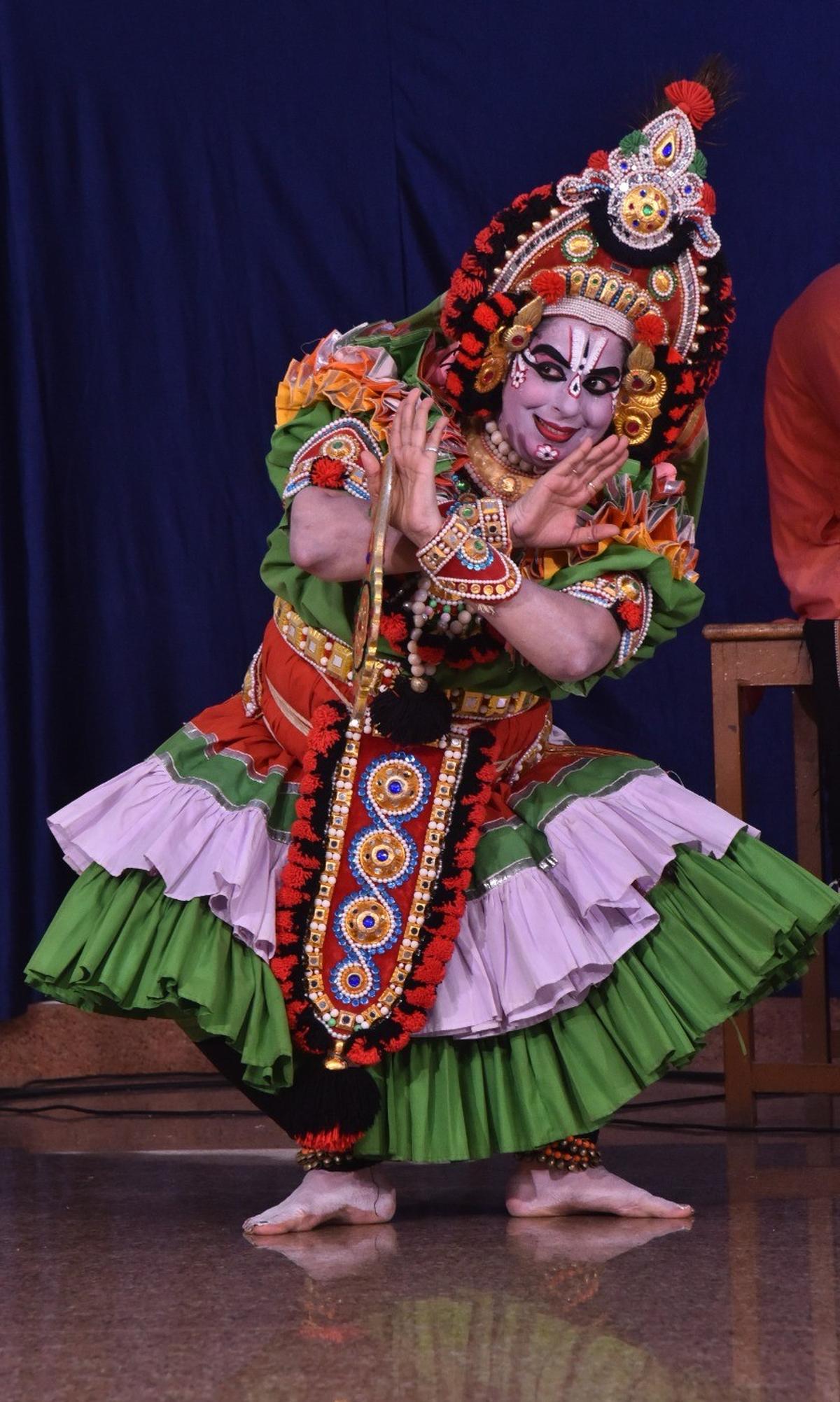
Sumangala Ratnakar Rao, a trained Bharatanatyam artiste, started learning Yakshagana in 2009 at the age of 32. He has introduced the structured education of Bharatnatyam into Yakshagana training. | Photo Credit: Special Arrangement
Sumangala has introduced the structured education of Bharatanatyam to Yakshagana training. “Earlier, many people would learn for a program or event; now they learn it as an art with its nuances. At Yaksharadhana Kala Kendra, which Sumangala launched in 2009, she teaches eight basic steps to about 30 students, and balancing techniques for handling heavy costumes and hats.” He feels that Bharatnatyam has enhanced his Yakshangana dance. The irony is that most female actors are best known for their male roles. Purnima is known for her Kansa, Mahishasura and Arjuna depictions, while Sumangala’s Krishna is extremely popular. Their goddesses, Satyabhama and Dakshinayini also attract crowds. Sumangala envisions a day when male and female Yakshagana artists will be given equal respect and both will help each other improve their art. With the entry of more women into the field, there have been some changes – primarily separate changing rooms and restrooms.
Women in Yakshagana say that they feel closer to their native land when they climb the stage. “Doing Yakshagana has given a purpose to my life because I am carrying forward a legacy,” says Sumangala.
published – March 06, 2026 01:58 PM IST