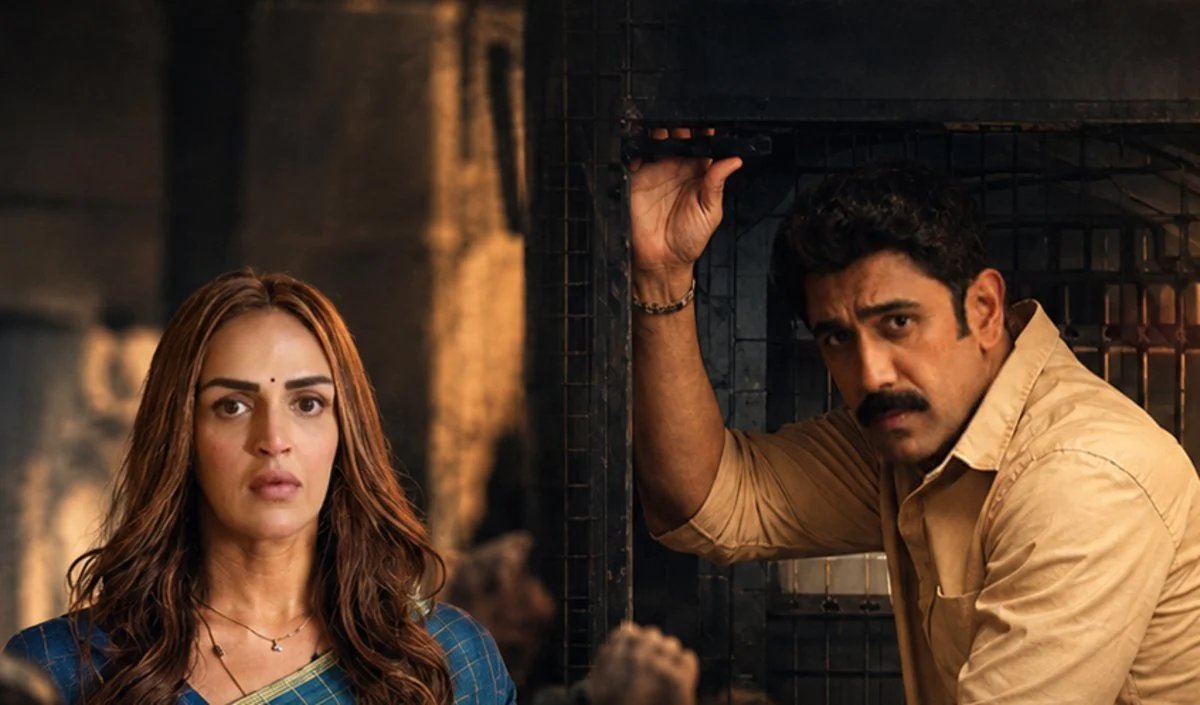
Many films in Indian cinema capture the attention of audiences because of their strong themes, while some are remembered for the struggles and emotional depth of their characters. These two aspects have been seen together in director Sachin Saraf’s film ‘Prataap’. The story is about a police officer, whose name used to scare criminals, but circumstances have changed such that now he has to fight hard to prove himself innocent. The story of the film is interesting and raises many sharp questions on the police system, social media, media trials, politics and judicial process. Basically, the film shows how a common man or an officer gets caught up in all these systems and pressures.
Pratap: The story
The film begins within the prison walls, where the atmosphere is extremely tense. The prisoner’s aggressive behavior makes it difficult for the policemen to control him. But this is no ordinary criminal—this is Pratap Ranade (Amit Sadh), a former encounter specialist of the Mumbai police. Seeing his brutal and aggressive behavior, Jailer Meera Sen (Seema Biswas) decides to send him to ‘Anda Cell’ (high-security cell).
The story first presents Pratap’s current situation and then reveals the layers of his past through flashbacks. Pratap has been such a brave police officer that even criminals used to tremble. His strict attitude, ability to take quick decisions and fearless action against criminals have made him stand out in the department. For him, standing against crime is not just a job but a duty. But an unexpected event turned his entire world upside down.
Pratap reached there with his team after receiving information about the hiding of a fugitive criminal in the residential area. The police capture the culprit, but during the operation he suffers a heart attack and dies. A girl present at the spot recorded the entire incident on her mobile phone. In no time this video goes viral on social media. Because only a fraction of the footage is exposed to the public, the perspective of seeing and understanding the event changes. Within no time, Pratap is seriously accused of murdering the criminal.
Here comes the big twist in the story. The same officer who put the criminals behind the bars for years, he is standing as an accused before the law. After the controversy that arose from the viral video, Pratap faced legal action and was eventually sent to jail.
In the beginning, Pratap feels that the truth will come out once the investigation is over and he will be exposed soon. He is confident that his integrity and clean image in the department will serve him for years to come. But as soon as he reaches the jail, he realizes the bitter truth that everything has changed. Now he has neither the power in uniform, nor the support of his team nor the influence he once used to make decisions.
Pratap has to live among the criminals inside the jail. It is a completely new and harsh world for him, where the meaning of external power and status changes. This conflict between the identity of a downtrodden police officer and the helplessness of an inmate drives the film’s story forward.
Meanwhile, the interference of politics and system makes the whole matter more complicated. Pratap slowly realizes that his fight is not limited to viral videos or legal charges. He has to contend with a system where it may be easy to know the truth, but very difficult to prove it. Will Pratap be able to prove his innocence? Will he be able to turn the tide in his favor and regain his lost honor? The film revolves around these questions.
Pratap: Direction
Director Sachin Saraf has chosen a subject that has full scope for entertainment as well as social commentary. The best thing about the film is that it doesn’t limit itself to the conventional action or conflict between police and criminals. Instead the director tries to explore the mental state of an officer who suddenly loses his identity, credibility and trust.
Major part of the film has been shot inside the prison. Despite the limited space, the story remains tense. The script, woven between past and present, helps the audience understand Pratap’s situation and his mindset. Saraf has also given place to the emotional aspects, so that it is not just a series of events.
However, the pace of the script slows down at some places. Some parts especially after the interval were not as impressive as expected. Some of the twists and turns in the story could have been crafted better. Despite these shortcomings, the film does not deviate from its main theme.
Pratap: Acting
Amit Sadh is the biggest strength of this film. He has played the role of IPS officer Pratap Ranade with full confidence and credibility. Both the authority of an officer in uniform and the helplessness of a man struggling for his innocence and dignity in prison are clearly reflected in his performance.
Amit’s greatest virtue is that he does not unnecessarily dramatize the character’s anger or rage. His expressions, dialogue delivery and natural style of playing emotional scenes bring Pratap’s character to life. His work is particularly effective in the prison scenes, where on several occasions his mere presence heightens the tension of the scene. Overall, Amit Sadh has carried the entire film on his shoulders with his powerful acting.
Seema Biswas looks very tough and impressive in the role of Jailer Meera Sen. Her tough personality and serious attitude make the prison scenes more realistic. With his experience, he has brought good weight even to a limited character.
Tigmanshu Dhulia and Milind Gunaji look comfortable in their respective roles and their screen presence supports the story. Esha Deol’s work has been average; If her character had a little more depth, she could have made a greater impact. Other supporting actors including Dushyant Wagh have also done justice to their respective roles.
Pratap: The technical side
The film is technically satisfactory. Cinematographer Anil Akki has effectively captured the closed, gloomy and oppressive atmosphere of the prison. Framing and camera movement help to highlight the tension and anxiety of the characters, which matches the mood of the story well, especially in the prison scenes.
The background score adds to the seriousness and tension of several important scenes. It supports the emotional impact of the story rather than overpowering it. The editing of the film is fine for the most part, although some scenes could have been shortened a bit and the pace of the film could have been brisker. Production design helps maintain the realistic atmosphere of the film.
Pratap: What is good and what could have been better?
What’s good:
Appropriate subject of the film and strong acting by Amit Sadh.
The journey from an overbearing officer to a helpless prisoner makes the story interesting.
Engaging with contemporary issues such as viral videos, misinformation and media trials.
Collaboration with other experienced artists including Seema Biswas.
What could have been better:
The screenplay is uneven at some places and the pace slows down.
Some events need to be shown in more detail and attention.
A little more depth into the political and system-related aspects would have made the impact more profound.
Some of the twists and turns are predictable, which weakens the thriller element a bit.
Pratap: Should you watch this movie?
Overall ‘Pratap’ is a film based on a serious subject. Through the struggles of a police officer, it questions the system, justice and the power of social media. Although the film doesn’t hit the mark on every front and the script has some flaws, its subject matter, emotional moments and the cast make it worth a watch.
Amit Sadh’s powerful acting is the life of this film. If you like police dramas, stories set in prisons and movies with characters fighting against the system, ‘Pratap’ is a must watch. At the same time, if you are looking for a fast-paced thriller full of constant twists and surprises, some parts of it may feel slow to you.
Rating: 3/5 stars