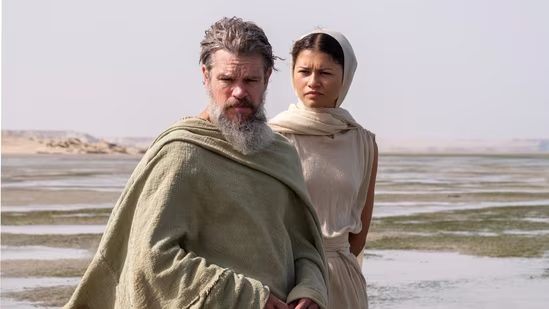
“No one obeys God’s will“…but fortune also favors the brave. Few films capture that idea better than Christopher Nolan’s brilliant adaptation of Homer’s Greek epic The Odyssey.
Fortune also sometimes provides moviegoers with the ultimate theatrical experience: a packed house, phones spaced far apart, no chatter, no interruptions – just hundreds of people sitting in silence for nearly three hours. Watching The Odyssey in that environment begs the question that lingers long after the credits roll: What motivates a man who has already reached the absolute pinnacle of filmmaking to aim even higher?
Envisioning a film like The Odyssey – and believing you can do it – is an ambition that borders on madness. Christopher Nolan doesn’t just accept that madness; He turns it into one of the most daring cinematic spectacles of his career.
Nolan’s script takes great care not to burden the audience with prior knowledge of Homer’s The Odyssey. You don’t need to have read the epic or even be familiar with Greek mythology to follow the story. Consider the film as a completely fresh story, and it still makes emotional and narrative sense.
Since Hollywood films are subjected to a mandatory (read: forced) hiatus in Indian theatres, it is appropriate to watch The Odyssey in two parts as well. The early hours are undeniably dense. Nolan has included a tremendous amount of information and characters that demand the audience’s full attention. This may seem tiring before you finally achieve your goal. Still, what the film gains in density, it loses in repetition. Nolan trusts his audience so much that he doesn’t over-explain every plot point or its themes, allowing the story to breathe once the initial hurdle of information subsides.
Also read: Special The manager of the Mumbai cafe who invited Nolan, Tom and Matt for tea says, ‘Don’t know them, Googled them later’
It’s when Odysseus’s perilous journey home really begins that the film justifies the big-screen experience. This film reviewer saw it in IMAX in India, with no reference for comparison in the 70mm presentation (unavailable in India). Still, one thing is undeniable: this is a movie designed to be experienced on the biggest screen possible.
The final hour of The Odyssey is undoubtedly its greatest strength, as every thread comes together in a deeply satisfying payoff. Don’t be surprised if this brings back memories of Ramayana. Themes of war, exile, homecoming and even the futility of swayamvara find place here, making Homer’s epic feel familiar to Indian audiences.
The acting further strengthens this film. Matt Damon gives Odysseus a calm resolution, while Tom Holland brings sincerity to his role as Telemachus. But it’s Robert Pattinson as the dangerous Antinous and Anne Hathaway as the loyal Penelope who leave the deepest impression. Pattinson plays a formidable antagonist, while Hathaway grounds the film with emotional flexibility. Ludwig Goransson’s spirited score complements Nolan’s vision, adding weight to both the spectacular and quieter moments.
Overall, The Odyssey is easier to admire than to love. The scale of it is staggering, the craftsmanship undeniable. But its emotional pull isn’t always as immediate as its visual grandeur. Still, Nolan delivers a thoughtful and rewarding adaptation that captures the spirit of Homer’s epic without reducing it to mere show. This alone makes it one of the most worthwhile big screen experiences of the year.