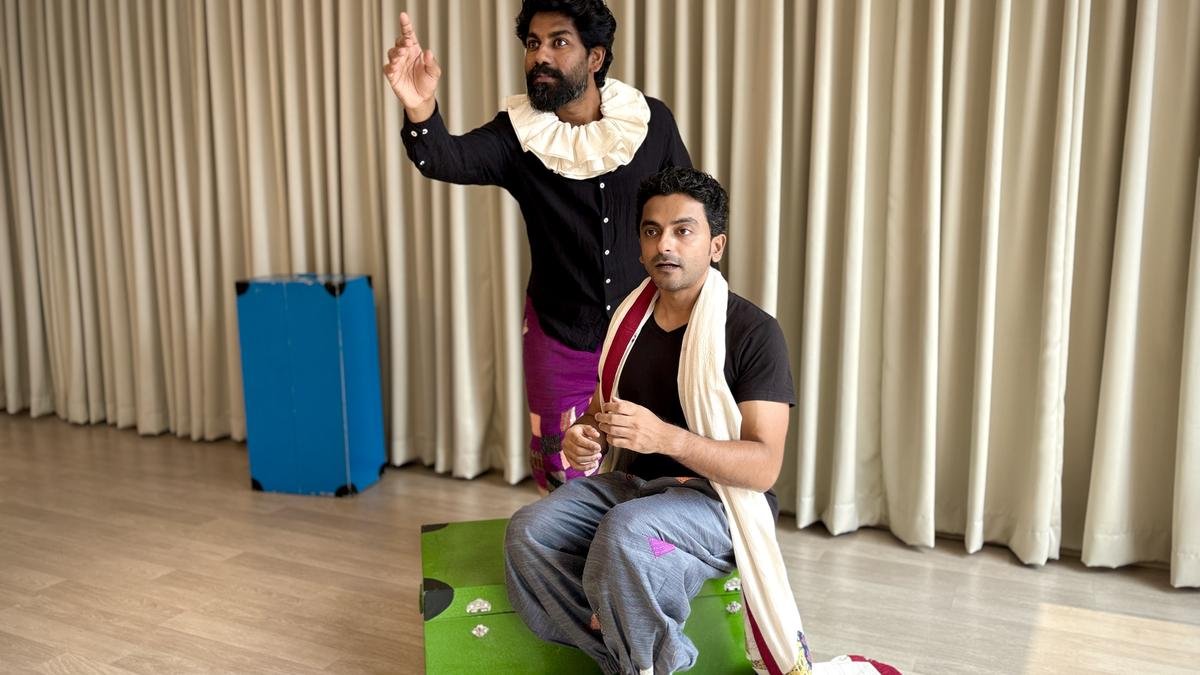
Rahul Thomas and Abraham Vadakkan Photo Credit: Special Arrangement
Two actors, Mano and Gomi, are waiting on the stage. Caught between performance and reality, they ponder the meaning of ‘waiting’. Through calmness, absurdity and a dash of humor, they take the audience into their thrall. In the fourth production of Rasa Theater Collective, several thousand years, The concept of waiting is central.
Written by Aparna Ashok, a participant of Ardhaviram, Rasa’s theater training program, the one hour 50-minute play in English is a reflection of the complexities and possibilities associated with the idea of waiting.

Inspired by the iconic work of Samuel Beckett, waiting for godotThe play is based on the turmoil of an actor. Theater producer Rahul Thomas, who has directed the play and essay Mano, says, “Though it tells the story through actors, it will hit everyone who has ever had to wait for something and knows what it feels like to wait.” “Here, the wait could be for a role, a character or an opportunity. It dives into the inner world of an actor, which is sometimes full of uncertainty and anticipation,” says Rahul.
The artistic director of Raas, Rahul has been training actors for over five years and says each actor has experienced the ‘waiting’. Rahul says, “It’s a competitive industry, especially today, and waiting is an inevitable aspect of an aspiring actor’s life. Through this play, we are taking a look at the philosophical question of waiting and what we do while waiting.”

Abraham Vadakkan and Rahul Thomas Photo Credit: Special Arrangement
Created by actors Abraham Vadakkan (who plays Gomi) and Rahul, the play took one and a half years to make. It deals with the situations and struggles that every actor goes through. For example, Gomi, who constantly struggles with a feeling of powerlessness, gets the role of Bheem and does not want to give up the character, while Mano, who gets the role of Hamlet, is torn between faith and doubt.

Aparna Ashok Photo Credit: Special Arrangement
Rasa’s three-day theater training programme, Aarambham, has been a huge success. “In December 2026, we will organize the 50th edition of Aarambham,” says Rahul, whose teaching methodology has evolved. “Initially, I was looking for honesty and truth in performance, but now, it has more to do with expanding the actor’s scope and truth is a by-product of that. Acting comes from an intimate place. The aim of these workshops is to help people get in touch with themselves, understand the areas where they feel limited and work on them. For example, for many aspiring female actors who come for training, it is often challenging for them to take up physical space and let their authentic voice come out. And with men, it’s insecure that they find it difficult. In the workshop, we really try to push their imagination and use their body and voice,” says Rahul.
several thousand years Supported by AAL Studios. The play’s music is composed by Sujit VV, lights by Arvind MS, costumes by Marianna Kurian and sets by Manu Mohan. Production support is by Joel Simon and Aparna Hari.
It will be held on November 21 and 22 at 6.30 pm at Ala Center for Culture, Mulanthuruthy. For tickets (price ₹400) contact 8921752062 / 9847613100
published – November 20, 2026 03:25 PM IST