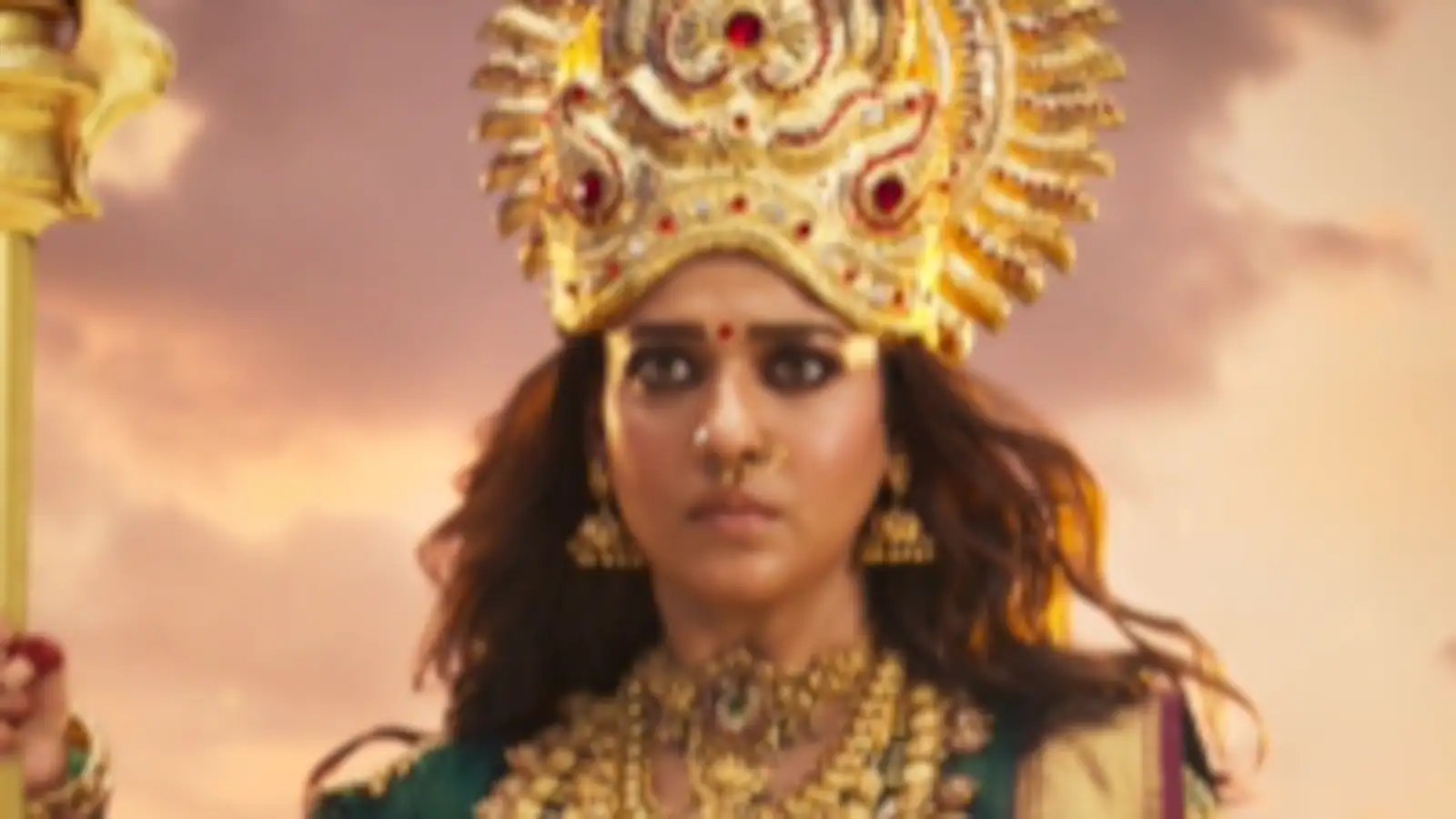
Ever since director RJ Balaji’s Mukuthi Amman came out in 2020, there has been talk of a possible sequel with Nayanthara returning to reprise her role as Brahm Devi.
Director Sundar C was roped in for the film’s sequel, Mukuthi Amman 2, with the hope that it would be bigger and grander than the first.
RJ Balaji is known for using humor and social commentary to address issues related to religion, superstition and exploitation of people’s beliefs, while Sundar C focuses more on commercial entertainment packed with comedy and targeting family audiences.
And this difference is quite evident in the treatment and presentation of Mukuthi Amman and Mukuthi Amman 2.
The story of Mukuthi Amman 2 moves between two timelines, spanning a distance of about 2,000 years.
In the present day, Shakti (Nayantara) is a young police constable who lives with her mother (Urvashi).
When she starts experiencing recurring nightmares in which she sees herself traveling to a village called Melanji, she decides to visit the place to understand the significance of these visions.
This is when the narrative takes us to the past, introducing us to a queen who sacrifices her son to the goddess Mahashakti to protect her from evil.
The battle between good and evil begins here as Bhaira (Regina Cassandra), a powerful witch who worships Satan, eagerly awaits her chance to take revenge on the goddess Amman for killing her husband.
As the film cuts between past and present, we witness the escalating conflict between Bhaira and Devi, and how the witch resurrects herself from the dead at a time when all the planets are aligned.
What follows is a whirlwind of sorcery, sorcery and supernatural powers, with the film attempting to weave mythology, fantasy and contemporary storytelling.
As one might guess, the story is ultimately about the forces of evil (Bhaira and his men) triumphing and the good (Amman) bringing happiness, joy and peace to the world.
The original story has the potential to make an exciting and engaging fantasy thriller, but director Sundar Si and writer Venkat Raghavan chose to focus on the battle between demonic and divine forces, and this is where the film loses its way.
Instead of building suspense and developing characters, the narrative becomes increasingly predictable, relying on familiar tropes such as devil worship, human sacrifice and elaborate conflicts between satanic and divine forces.
Episodes set in the past, featuring Bhaira, recall Hollywood fantasy films such as The Mummy and Gods of Egypt, which explore ancient curses, dark rituals, resurrections and battles between divine and demonic forces.
However, Mukuthi Amman 2 lacks the narrative thrust and captivating storytelling that makes these films so interesting.
The confrontation between Bhaira and Amman feels routine and unnecessary rather than a face-off between good and evil.
One is left wondering what the film is actually trying to say, as the screenplay loses sight of the story after a while. The lavish sets, ornate costumes and ghosts created by the VFX don’t really fill the gap left by the absence of a solid story.
Despite the presence of actors like Nayanthara, Dunya Vijay, Kushboo Sundar, Regina Cassandra, Sneha, Urvashi and Yogi Babu, the film was a major disappointment.
Mukuthi Amman films rest on the shoulders of Nayanthara, with the star lending both grace and authority to the titular goddess. Her screen presence is undoubtedly the biggest strength of the franchise, but even her star power cannot compensate for a weak screenplay in Sundar See’s film.
Regina Cassandra makes a great villain and gives a committed performance even though she is on the glam quotient in this film.
Urvashi as Yogi Babu brings some much needed spontaneity to the proceedings which manages to elicit some laughs. Dunya Vijay makes an impact but doesn’t have much to do in this female-dominated and female-led film.
The music director, Hiphop Tameeza, also ensures that the devotional qualities are enhanced in this film, with an exquisite orchestral treatment and a highly energetic background score and songs that enhance the presence of the Goddess.
The music adds to the film’s reverent atmosphere, even if it doesn’t make up for the shortcomings of the screenplay.
Devotional cinema need not be restrictive or follow any particular format – what makes devotional cinema ultimately work is the emotional and spiritual connection it establishes with the audience.
Director Sundar C’s Mukuthi Amman 2 has star power, scale and technical resources but lacks a solid screenplay that brings these elements together beautifully.
Mukuthi Amman 2 is a divine spectacle that desperately needed a storytelling miracle.